
Introduction
Aircraft spoilers are important aerodynamic surfaces found on many modern aircraft, but their purpose can be confusing to people who are new to aviation. Unlike the everyday meaning of the word “spoiler,” these devices have a specific role in controlling airflow, lift, and drag. They can be used during different stages of a flight, including descent and landing. Understanding how spoilers work provides a useful introduction to some of the basic principles of aircraft aerodynamics.
Main Content
What Are Spoilers on an Aircraft?
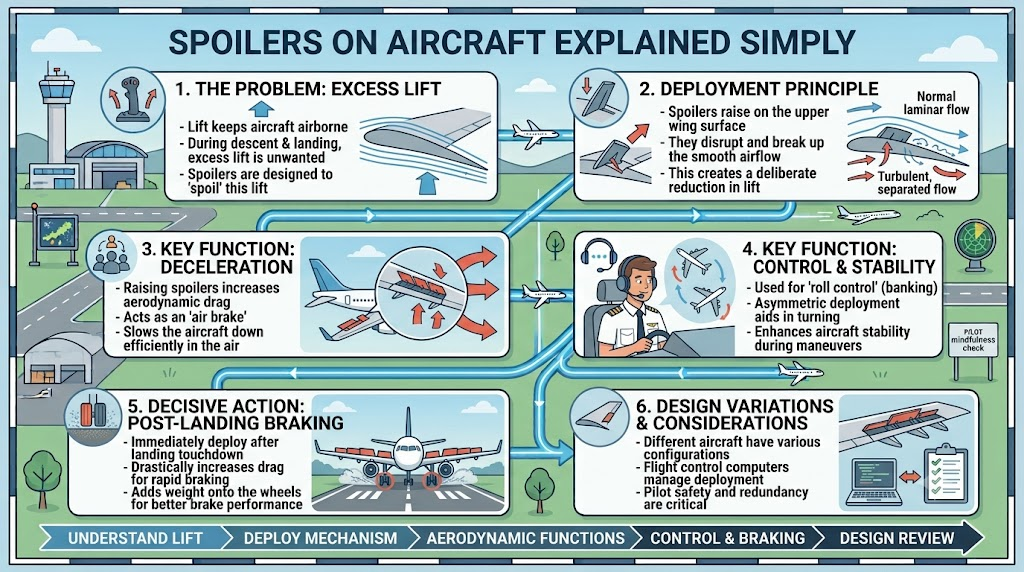
Spoilers are movable panels located on the upper surface of an aircraft’s wing. When they are not being used, they normally remain close to the wing surface. When deployed, they rise into the airflow and disturb the smooth flow of air over part of the wing.
This disturbance changes the aerodynamic characteristics of the wing. In general, deploying a spoiler reduces lift and increases drag.
The exact design and operation of spoilers vary between aircraft. Some aircraft have several spoiler panels along each wing, and individual panels may have different functions depending on the aircraft’s design.
The basic idea, however, is relatively simple: spoilers change the airflow over the wing to reduce lift and, in many situations, increase drag.
How Do Aircraft Spoilers Work?
To understand spoilers, it helps to understand the basic relationship between airflow and lift.
When an aircraft is flying, air moves around its wings and contributes to the aerodynamic forces that allow the aircraft to remain airborne. A spoiler interrupts part of this airflow when it rises from the wing.
When a spoiler is deployed:
- The spoiler panel rises above the wing.
- It disrupts airflow over part of the wing.
- The affected section produces less lift.
- Drag generally increases.
- The aircraft’s aerodynamic behavior changes.
The amount of lift and drag produced depends on the aircraft design and how the spoiler system is used.
A simple way to think about a spoiler is as a device that temporarily makes part of the wing less effective at producing lift.
Why Are Spoilers Used?
Spoilers have several important functions. Their exact roles differ depending on the aircraft, but common uses include:
- Helping manage aircraft speed.
- Supporting descent management.
- Reducing lift when required.
- Increasing aerodynamic drag.
- Assisting during landing.
- Helping transfer aircraft weight onto the landing gear after touchdown.
- Contributing to roll control on some aircraft.
This means spoilers are not simply devices for slowing an aircraft. They can play several roles within the aircraft’s aerodynamic and control systems.
Spoilers During Descent
During a descent, pilots may sometimes need to manage the aircraft’s energy. An aircraft can have both altitude and speed that need to be controlled appropriately.
Spoilers can help increase drag and reduce lift, allowing an aircraft to change its flight path without relying only on other methods of controlling speed and descent.
For example, imagine an aircraft that needs to lose altitude while maintaining an appropriate speed. Depending on the aircraft and flight situation, spoilers may help increase drag and alter the aircraft’s descent characteristics.
The exact use of spoilers during a descent depends on the aircraft type, operating procedures, and the specific flight situation. Students should learn the correct procedures for the aircraft they are trained on rather than applying general information to every aircraft.
Spoilers During Landing
Spoilers are particularly important during the landing phase.
After an aircraft touches down, it is no longer necessary to keep producing as much lift as it needed while airborne. Ground spoilers can deploy to reduce lift and increase drag.
Reducing lift helps place more of the aircraft’s weight onto the landing gear. This can improve the effectiveness of the aircraft’s wheel brakes because the tires have greater contact force with the runway.
At the same time, the additional drag created by the spoilers contributes to slowing the aircraft.
This makes spoilers an important part of the overall landing system on many aircraft.
Spoilers and Speed Brakes
The terms “spoiler” and “speed brake” are sometimes used together, but they are not always exactly the same thing.
A speed brake is a system or aerodynamic function intended primarily to increase drag and help control speed or descent. On many aircraft, spoiler panels perform this function.
In other words, some spoilers can act as speed brakes.
The exact terminology and design depend on the aircraft. Some aircraft may have spoiler panels specifically configured for different functions, while others may use the same basic surfaces for several purposes.
Ground Spoilers
Ground spoilers are spoiler panels used primarily after an aircraft has landed.
Their main aerodynamic purpose is to reduce lift after touchdown. This helps the aircraft settle more firmly onto the runway and allows the landing gear to support more of the aircraft’s weight.
Ground spoilers can also contribute to deceleration by increasing drag.
On many modern aircraft, their deployment is integrated with the aircraft’s landing and control systems. However, the exact activation method and conditions vary by aircraft type.
Flight Spoilers
Some aircraft use spoilers while they are still airborne. These are often referred to as flight spoilers when discussing their in-flight function.
Flight spoilers can help manage speed, descent, or aircraft energy. On some aircraft, spoiler surfaces can also contribute to roll control.
The use of spoilers in flight is aircraft-specific. Their operation depends on the aircraft’s design and the procedures established for that aircraft.
Spoilers and Roll Control
Some aircraft use spoiler panels as part of their roll-control system.
When an aircraft needs to roll, the control system can change the aerodynamic forces on the wings. On certain aircraft, spoiler panels can assist the ailerons by reducing lift on one side of the aircraft.
For example, raising a spoiler on one wing can reduce lift on that wing, while the other wing continues producing comparatively more lift. This difference in lift can contribute to a rolling motion.
Spoilers do not replace ailerons on every aircraft. Their role in roll control depends on the aircraft’s design.
Spoilers vs Flaps
Spoilers and flaps are both located on aircraft wings, but they generally serve different purposes.
Flaps are usually deployed to change the wing’s aerodynamic characteristics in a way that increases lift, while also increasing drag. They are commonly associated with takeoff and landing.
Spoilers generally reduce lift and increase drag when deployed.
This difference is one of the easiest ways for beginners to distinguish the two systems.
What Happens When Spoilers Deploy?
The aerodynamic changes can be summarized simply.
When a spoiler rises from the wing:
- Smooth airflow over part of the wing is disturbed.
- The affected section produces less lift.
- Drag increases.
- The aircraft’s energy and flight characteristics change.
- During landing, reduced lift can help place more weight on the landing gear.
The precise effects depend on the aircraft, the spoiler design, and how much of the spoiler system is deployed.
Practical Explanation
Consider an aircraft approaching a landing.
While the aircraft is airborne, its wings need to generate enough lift to support its weight. After touchdown, maintaining the same level of lift is no longer desirable because the aircraft needs to remain firmly on the runway while slowing down.
Ground spoilers can help by reducing the wing’s lift-producing ability. More of the aircraft’s weight is then supported by the landing gear, while the spoilers also contribute aerodynamic drag.
Now consider a different situation during descent. If an aircraft needs to lose altitude while managing its energy, additional drag can be useful. Depending on the aircraft and applicable procedures, spoilers may help achieve the desired aerodynamic effect.
These examples show why spoilers are more than simple “brakes.” Their function is closely connected to how aircraft manage lift, drag, and energy.
Main Functions of Aircraft Spoilers
| Spoiler Use | Basic Purpose | When It May Be Used |
|---|---|---|
| Speed control | Increase aerodynamic drag | During appropriate phases of flight |
| Descent management | Help control aircraft energy and descent | During flight when applicable |
| Ground spoilers | Reduce lift and increase drag | After touchdown |
| Landing assistance | Help place more weight on the landing gear | During the landing rollout |
| Roll assistance | Reduce lift on part of a wing | On aircraft designed to use spoilers for roll control |
Common Misunderstandings About Aircraft Spoilers
Spoilers Are Only Used to Slow an Aircraft
This is one of the most common misunderstandings.
Spoilers can increase drag and therefore help slow an aircraft, but they also reduce lift. They may have additional functions, including descent management and roll assistance on certain aircraft.
Spoilers and Flaps Do the Same Thing
They do not.
Although both systems are associated with the wings, their aerodynamic effects are generally different. Flaps are designed to modify the wing to produce more lift, particularly during lower-speed phases of flight, while spoilers generally reduce lift when deployed.
Every Aircraft Uses Spoilers in the Same Way
Aircraft designs vary considerably.
The number of spoiler panels, their size, their control systems, and their functions can differ between aircraft. Information about one aircraft should not automatically be applied to another.
Spoilers Make an Aircraft Stop Flying
Spoilers reduce lift over the portion of the wing where they are deployed, but that does not mean the aircraft simply stops flying when spoilers are used.
Their effects depend on the aircraft’s design, flight condition, and level of deployment.
Spoilers Are the Same as Air Brakes
The terminology can vary.
A speed brake or air brake is generally associated with increasing drag to control speed or descent. On many aircraft, spoilers provide this function. However, the exact system arrangement differs between aircraft.
Comparing Common Aircraft Control Surfaces
| Control Surface | Main Effect | General Purpose |
| Spoilers | Reduce lift and generally increase drag | Speed, descent, landing, and sometimes roll control |
| Flaps | Increase lift and drag | Supporting lower-speed flight, especially takeoff and landing |
| Ailerons | Change lift between wings | Roll control |
| Elevators | Change the aircraft’s pitching tendency | Pitch control |
| Rudder | Changes aerodynamic force at the vertical tail | Yaw control |
Important Considerations
The most important point to remember is that spoiler systems are aircraft-specific.
A large commercial aircraft may have a sophisticated spoiler system with multiple panels and different control functions. A smaller aircraft may have a completely different wing-control arrangement or may not use spoilers in the same way.
The terminology can also vary. Terms such as flight spoilers, ground spoilers, speed brakes, and lift dumpers may be used differently depending on the aircraft and its documentation.
For aviation students, general aerodynamic knowledge is useful for understanding the purpose of spoilers, but actual operation should always be learned from the appropriate aircraft manuals, instructor, and approved training material.
Spoilers should also be understood as part of a larger aerodynamic system. Their effects interact with other control surfaces and aircraft systems rather than operating independently from everything else.
Finally, spoilers are not emergency devices in the simple sense that the word might suggest. They are deliberately designed aerodynamic surfaces with specific purposes and operating limitations.
Frequently Asked Questions
1. What are spoilers on an aircraft?
Spoilers are movable panels on the upper surface of an aircraft wing. When deployed, they disturb airflow over the wing, generally reducing lift and increasing drag.
2. Where are aircraft spoilers located?
Spoilers are generally located on the upper surface of the wings. Their exact position, number, and size vary depending on the aircraft design.
3. What do spoilers do on an aircraft?
Spoilers can reduce lift and increase drag. Depending on the aircraft, they may be used for speed control, descent management, landing, and roll assistance.
4. How do spoilers reduce lift?
When a spoiler panel rises above the wing, it disrupts the airflow over part of the wing. This reduces the aerodynamic effectiveness of that section and therefore reduces lift.
5. Are spoilers the same as speed brakes?
Not exactly. A speed brake refers to a function or system used to increase drag and manage speed or descent. On many aircraft, spoiler panels perform this function.
6. What are ground spoilers?
Ground spoilers are spoiler surfaces used after landing to reduce lift and increase drag. By reducing lift, they help transfer more aircraft weight onto the landing gear.
7. Why are spoilers used after landing?
After touchdown, reducing lift helps keep the aircraft firmly on the runway. This allows the landing gear to support more weight and can improve the effectiveness of wheel braking.
8. Can spoilers help an aircraft turn?
On some aircraft, spoiler surfaces can contribute to roll control by reducing lift on one side of the wing. Their exact role depends on the aircraft’s design.
9. What is the difference between spoilers and flaps?
Spoilers generally reduce lift and increase drag when deployed. Flaps generally increase lift and drag and are commonly used during takeoff and landing.
10. Do all aircraft have spoilers?
No. Aircraft designs differ, and not every aircraft uses spoiler systems in the same way. Their presence and functions depend on the aircraft’s design and intended operation.
Conclusion
Aircraft spoilers are relatively simple in concept but perform several important functions. By disturbing airflow over the wing, they generally reduce lift and increase drag, allowing them to support speed control, descent management, landing, and, on some aircraft, roll control.
Their role during landing is especially important because ground spoilers can reduce lift after touchdown and help transfer more weight to the landing gear. This works alongside other aircraft systems to support effective deceleration.
For beginners, the easiest way to remember the basic concept is that spoilers make part of the wing less effective at producing lift while increasing drag. Their exact functions and operating methods vary between aircraft, so detailed operation should always be learned from approved aircraft-specific training material.

