
Introduction
Writers and independent creators often have valuable ideas but lack a simple place to publish them. Building a traditional website may involve purchasing hosting, choosing a domain, configuring technical settings, and maintaining the site. These requirements can make online publishing feel difficult, especially for beginners.
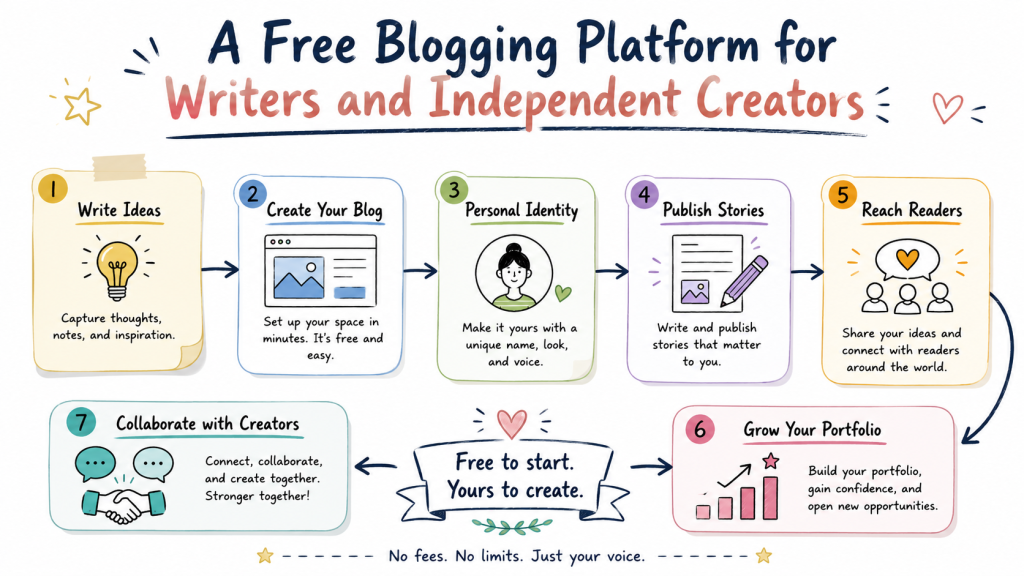
A free blogging platform reduces many of these barriers. It gives writers a ready-to-use space where they can create articles, publish stories, organise their ideas, and begin developing an online identity. Instead of spending time managing technical systems, creators can focus on producing meaningful content.
Free blogging is useful for storytellers, students, educators, professionals, poets, hobbyists, and subject-matter experts. Whether someone wants to document personal experiences, share professional knowledge, or publish creative work, a simple online blogging platform can provide a practical starting point.
This guide explains how free blogging platforms support independent creators, which features matter most, how to begin publishing, and how writers can build a sustainable writing practice.
Understanding a Free Blogging Platform
A free blogging platform is an online publishing service that allows people to create and publish blog posts without paying for traditional website hosting. The platform normally provides the basic publishing system, content editor, blog structure, and reading experience.
For beginners, this means there is no need to build a website from the beginning. Writers can create an account, prepare their profile, choose a blog identity, and start publishing through a simple interface.
A free blogging site is different from a private document editor. A document stored on a computer is usually visible only to its owner or selected people. A published blog post can become part of a public writing portfolio and may be discovered by readers interested in the same subject.
Free blogging platforms may also offer a personal subdomain. A subdomain gives a blog its own identifiable address within the main platform. It helps writers create a separate publishing space without purchasing an independent domain.
For example, an independent creator may use a personal blog to publish:
- Educational articles
- Professional insights
- Short stories
- Poetry
- Travel experiences
- Career lessons
- Personal reflections
- Technology tutorials
- Business knowledge
- Creative projects
The main advantage is accessibility. Writers can start learning how online publishing works without making a large financial or technical commitment.
The Value of Blogging for Independent Creators
Independent creators often work without a large organisation, publishing team, or marketing department. A personal blogging platform gives them a space they can use to present their work directly to readers.
Developing a Recognisable Writing Identity
A writing identity is the combination of subjects, ideas, tone, experience, and perspective that readers associate with a creator.
Publishing regularly helps writers develop this identity. A technology professional may become known for beginner-friendly tutorials. A traveller may focus on local culture and practical experiences. A creative writer may publish short fiction based on everyday life.
A clear identity does not appear after one article. It develops as writers publish consistently and improve their communication.
Building a Public Portfolio
A blog can serve as an organised collection of published work. Students may use it to demonstrate writing ability, while professionals may use it to present industry knowledge.
A public portfolio can be useful when applying for educational opportunities, freelance assignments, collaborations, internships, or professional roles. It allows people to review the creator’s actual work instead of relying only on a short description of their skills.
Practising Communication Skills
Writing for public readers requires clarity. Authors must think about structure, examples, titles, paragraph length, and the reader’s level of knowledge.
This process can improve communication over time. Writers learn how to explain complex ideas, remove unnecessary words, organise information, and maintain a consistent tone.
Preserving Ideas and Experiences
Blogs can also serve as meaningful personal records. Writers can document lessons, projects, experiences, observations, and creative thoughts.
Unlike temporary social media updates, blog articles are normally written with more detail and structure. They can provide a deeper record of a creator’s thinking and development.
Important Qualities of a Blogging Platform for Writers
Not every platform provides the same experience. Writers should examine their own goals before choosing where to publish.
Simple Publishing Experience
A blogging website for beginners should make writing and publishing easy to understand. Complicated menus and technical settings may distract new writers from the actual purpose of blogging.
A simple blogging platform should allow creators to concentrate on:
- Preparing an article
- Editing the content
- Organising paragraphs
- Adding a clear title
- Reviewing the final post
- Publishing it for readers
A straightforward workflow is particularly valuable for people who do not have website-building experience.
No-Code Blog Creation
A no-code blogging platform allows users to publish without programming knowledge. Writers do not need to understand HTML, CSS, databases, or server management before sharing their ideas.
No-code publishing does not mean writers stop learning. Instead, it allows them to develop the skills that matter most at the beginning: research, planning, writing, editing, and reader communication.
Free Blog Hosting
Hosting is the online service that stores website content and makes it available to readers. Traditional websites normally require users to arrange and pay for hosting separately.
Free blog hosting removes this initial responsibility. The blogging platform manages the basic publishing environment, allowing the writer to use the available system.
This arrangement is helpful for beginners who want to test their interest in blogging before investing in a separate website.
Personal Subdomain Availability
A free blog with a subdomain gives a writer an individual space within the wider platform.
A personal subdomain can help creators:
- Separate their work from other writers
- Create a consistent publishing identity
- Direct readers to their collection of posts
- Organise articles under one blog
- Build familiarity around a chosen blog name
The name should be easy to remember, relevant to the writer’s subject, and flexible enough to support future content.
Comfortable Reading Across Devices
Readers may open an article on a desktop computer, laptop, tablet, or phone. A suitable online blogging platform should make published content readable across different screen sizes.
Writers can support readability by using descriptive headings, short paragraphs, simple sentences, and clear spacing. Even when the platform handles the basic layout, authors remain responsible for presenting information in an accessible way.
Community Discovery
Publishing alone does not automatically create a community. However, a community blogging platform can give writers opportunities to discover other voices and participate in a shared publishing environment.
Reading other creators can help writers understand different styles, subjects, structures, and perspectives. Respectful participation may also lead to useful discussions and creative connections.
Multi-Author Support
Some projects require more than one writer. A multi-author blogging platform allows multiple contributors to publish within a shared blog or publication.
This structure can support:
- Student publications
- Educational projects
- Professional knowledge hubs
- Community storytelling
- Collaborative magazines
- Team-based blogs
- Special-interest publications
Before inviting contributors, the blog owner should establish clear subjects, writing standards, editing responsibilities, and publishing expectations.
Starting a Blog Without Technical Confusion
A successful beginning does not require a complicated strategy. Writers can start with a clear purpose and improve gradually.
1. Define the Purpose
The first step is deciding why the blog should exist.
Possible purposes include:
- Teaching a subject
- Building a writing portfolio
- Sharing professional knowledge
- Publishing creative work
- Recording personal experiences
- Supporting a community project
- Practising public writing
A clear purpose makes future decisions easier.
2. Choose a Focused Subject
A blog can cover more than one subject, but beginners often benefit from starting with a clear focus.
“Technology” is very broad. “Simple cybersecurity guidance for small businesses” is more specific. “Travel” is also broad, while “budget travel experiences in small cities” provides a clearer direction.
A focused subject helps writers understand which readers they are trying to serve.
3. Select a Suitable Free Blogging Platform
The platform should match the writer’s needs. A beginner may value simplicity, free access, a personal subdomain, and a clear publishing workflow. A collaborative team may need support for multiple contributors.
Writers should choose based on practical requirements rather than exaggerated claims.
4. Create a Clear Blog Identity
The blog name, description, profile, and subject should communicate what readers can expect.
A useful description may explain:
- Who the writer is
- Which subjects the blog covers
- Who the content is written for
- What readers may learn or experience
The description should remain clear instead of trying to include every possible keyword.
5. Plan the First Articles
Before publishing the first post, create a small list of related ideas.
For a career-development blog, the first articles might cover:
- Creating a practical career plan
- Improving professional communication
- Developing useful workplace skills
- Preparing a project portfolio
- Learning from early career mistakes
Related topics make the blog feel organised and help the writer continue after the first article.
6. Write for a Specific Reader
Trying to write for everyone often produces vague content. A better approach is to imagine one type of reader.
An educational article may be written for a complete beginner. A professional analysis may be written for people who already understand the basic subject. A personal story may be written for readers who have experienced a similar situation.
Understanding the reader helps determine the language, examples, depth, and structure.
7. Edit Before Publishing
The first draft is rarely the strongest version. Writers should review their work for:
- Grammar mistakes
- Repeated ideas
- Unclear sentences
- Weak transitions
- Long paragraphs
- Misleading titles
- Unsupported statements
- Unnecessary keywords
Reading the article aloud can reveal awkward wording that may be difficult to notice silently.
8. Publish on a Realistic Schedule
Publishing every day is unnecessary for most beginners. A realistic schedule is more useful than an ambitious routine that cannot be maintained.
One detailed article every week or every two weeks may be more sustainable than several rushed posts. The ideal schedule depends on the writer’s time, research needs, and content style.
Practical Uses for Writers and Creators
A free platform for writers can support many different publishing goals.
Students
Students can create a blog to publish essays, research summaries, project reflections, book reviews, and learning notes. Over time, the blog may become a useful academic or creative portfolio.
Students should avoid publishing private institutional information or presenting unverified material as fact.
Professionals
Professionals can share lessons from their field, explain common problems, discuss industry practices, and publish educational guides.
The strongest professional articles usually teach something useful instead of simply promoting the writer’s services.
Educators
Educators can publish learning resources, subject explanations, reading suggestions, classroom reflections, and general study guidance.
Blogging may help educators present concepts in a format that learners can revisit at their own pace.
Storytellers and Poets
A platform for storytellers gives creative writers a place to publish short stories, serial fiction, poetry, character studies, and personal narratives.
Creative writers can organise their work by theme or format so readers can explore related pieces easily.
Subject-Matter Experts
People with specialised knowledge can make difficult subjects easier to understand. Experts may publish tutorials, definitions, practical examples, common mistakes, and introductory guides.
They should explain specialised terms and avoid assuming that every reader has the same background.
Collaborative Teams
A collaborative blogging platform can support projects involving several contributors. Each person may cover a different subject while publishing under a shared identity.
Clear editorial standards are essential. Without them, the publication may develop inconsistent quality, tone, and structure.
Common Blogging Challenges and Practical Solutions
Difficulty Finding Topics
Writers may believe they have nothing new to say. The solution is not always finding a completely original subject. A writer can add value through clearer explanations, personal experience, useful examples, or a different perspective.
Keep a list of questions people commonly ask about the subject.
Choosing an Overly Broad Direction
A broad blog can become difficult to organise. Instead of covering business, travel, technology, education, and lifestyle together, begin with one main area and a few related categories.
The blog can expand later when the writer has developed a stable publishing routine.
Publishing Inconsistently
Long breaks often happen when writers create an unrealistic schedule. Choose a frequency that fits normal responsibilities and prepare ideas in advance.
Consistency means maintaining a manageable routine, not publishing as often as possible.
Expecting Immediate Attention
A newly published article may not receive significant attention immediately. Audience development usually requires patience, useful content, repeated publishing, and respectful participation in relevant communities.
Writers should measure early progress through completed articles and improved skills rather than only visitor numbers.
Copying Popular Creators
Studying experienced writers can be educational, but copying their language or ideas damages originality.
Creators should use their own examples, experiences, explanations, and voice. Sources should be represented honestly when research is involved.
Forcing Keywords Into Articles
Keywords help search engines understand a topic, but excessive repetition makes content unpleasant to read.
Use the main phrase where it fits naturally, then include related terms and clear explanations. Reader usefulness should remain the priority.
Ignoring Proofreading
Small mistakes may reduce trust in otherwise useful content. Writers should allow time between drafting and editing when possible.
A final review should examine the title, opening, headings, conclusion, grammar, and factual statements.
Writing Tips for Sustainable Blog Growth
Sustainable growth begins with quality and consistency rather than shortcuts.
- Write original articles that solve a clear problem.
- Use descriptive titles that accurately represent the content.
- Open with the reader’s situation instead of a generic definition.
- Keep paragraphs short enough for online reading.
- Use examples to explain unfamiliar ideas.
- Organise long articles with meaningful headings.
- Avoid unsupported statistics and guarantees.
- Review older content and improve unclear sections.
- Develop a recognisable tone without copying another writer.
- Participate respectfully in the wider blogging community.
- Publish at a frequency that can be maintained.
- Learn from reader interests without abandoning the blog’s main purpose.
A strong blog is built article by article. Every post should add useful information, a thoughtful perspective, or a meaningful creative experience.
iBlogUp as a Free Blogging Platform
iBlogUp provides writers and independent creators with a simple environment for online publishing. Users can begin through Google-based sign-in and create a personal iBlogUp subdomain for their individual blog identity.
The platform supports no-code publishing, making it suitable for people who want to focus on writing rather than technical website management. Writers can publish informative articles, professional knowledge, personal experiences, stories, poetry, opinions, and other meaningful content.
Published work can appear within a shared discovery feed, helping readers explore different independent voices in the wider blogging community. The platform also supports multiple contributors, which can be useful for collaborative blogs and shared publications.
iBlogUp may be a practical option for beginners, professionals, educators, storytellers, and teams looking to start a blog for free. Its role is to provide the publishing space, while the writer remains responsible for originality, clarity, consistency, and reader value.
Frequently Asked Questions
1. Can beginners use a free blogging platform?
Yes. Free blogging platforms are often suitable for beginners because they reduce the need for separate hosting and technical website setup. New writers should still learn basic skills such as choosing a topic, structuring an article, proofreading, and writing for a particular audience.
2. Is coding required to create a personal blog?
Coding is not required when using a no-code blogging platform. Writers can normally create an account and publish through an existing interface. Basic technical knowledge may be helpful in the future, but it should not prevent beginners from starting their first blog.
3. What does a personal blog subdomain mean?
A subdomain is an individual blog address created within a larger blogging platform. It gives the writer a recognisable publishing space without requiring the purchase of a separate domain. Writers should choose a simple name that reflects their identity or main subject.
4. Which subjects can independent creators publish?
Independent creators can publish educational articles, personal experiences, professional insights, poetry, stories, opinions, travel writing, career guidance, lifestyle content, and other original work. The subject should follow the platform’s content rules and provide meaningful value to readers.
5. Can a free blog support a professional portfolio?
Yes. A blog can display writing ability, subject knowledge, communication skills, and completed projects. Professionals should organise their strongest work clearly and ensure that articles are accurate, well edited, and relevant to the type of opportunities they are pursuing.
6. How often should a new writer publish?
There is no universal publishing frequency. Beginners should choose a realistic routine based on their available time and the complexity of their content. Publishing one useful article every week or two is often better than producing frequent posts that lack research or careful editing.
7. Can several writers contribute to one blog?
A multi-author blogging platform can allow several contributors to publish within a shared space. Collaborative blogs work best when the team agrees on subjects, tone, formatting, editorial responsibilities, and publishing standards before inviting contributors.
8. Does free blogging guarantee an audience?
No platform can guarantee that an article will attract readers. Audience development depends on content quality, relevance, consistency, originality, community participation, and patience. Writers should focus first on creating useful work and improving their skills with each publication.
Conclusion
A free blogging platform gives writers and independent creators an accessible way to begin publishing without managing complicated website systems. It can support personal expression, professional knowledge sharing, creative storytelling, educational content, public portfolios, and collaborative publications.
The most important step is beginning with a clear purpose. Writers should identify their audience, select a focused subject, prepare useful article ideas, edit carefully, and follow a realistic publishing schedule. Meaningful progress comes from consistent practice rather than immediate attention.
iBlogUp offers free access, personal subdomains, no-code publishing, a shared discovery feed, and support for multiple contributors. These features can help individuals and teams establish an online writing presence while remaining focused on their content.

