
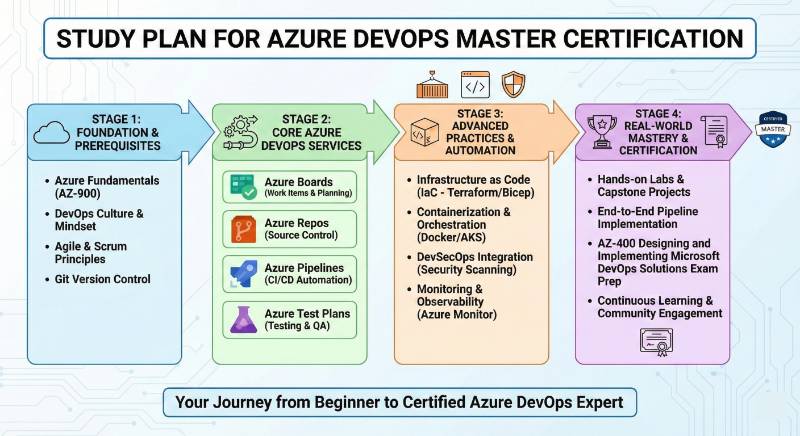
In my two decades navigating the shifting tides of software delivery—from the days of manual “rack and stack” servers to the modern era of ephemeral, AI-driven clouds—I’ve seen one constant: tools change, but the need for reliable, secure, and cost-effective systems never does. Today, Azure DevOps stands as the backbone for enterprises worldwide, bridging the gap between raw code and business value.
If you are a working engineer or a manager in India or abroad, you’ve likely noticed that “knowing” Azure isn’t enough anymore. The market demands Mastery. This guide is designed to help you navigate the Master in Azure DevOps Certification Program, a comprehensive track that transforms generalists into elite architects.
The Certification Landscape: Master in Azure DevOps
To reach the pinnacle of Azure DevOps, you need a structured path. Below is the comprehensive breakdown of the certifications that comprise the master-level expertise.
| Track | Level | Who it’s for | Prerequisites | Skills Covered | Recommended Order |
| Fundamentals | Beginner | Freshers, Managers, Stakeholders | None | Cloud Concepts, Azure Services, Security, Pricing | 1 |
| Administrator | Intermediate | SysAdmins, Cloud Ops, Support Engineers | AZ-900 (Recommended) | Identity, Governance, Storage, Compute, Virtual Networking | 2 |
| Developer | Intermediate | Software Engineers, Web Developers | AZ-900 (Recommended) | Azure SDKs, Serverless, Storage, Security, Monitoring | 2 (Optional alternative to AZ-104) |
| DevOps Expert | Advanced | DevOps Engineers, SREs, Architects | AZ-104 or AZ-204 | CI/CD, Instrumentation, Site Reliability, Compliance, SCM | 3 |
| Master Program | Master | Senior Lead Engineers & Managers | AZ-400 + Hands-on Projects | Full Stack DevOps, Terraform, Kubernetes, Multi-tool integration | Final |
Deep Dive: Master in Azure DevOps Certification
What it is
The Master in Azure DevOps is an elite, project-driven program provided by DevOpsSchool. It goes beyond the standard Microsoft curriculum by integrating essential third-party tools like Terraform, Docker, and Kubernetes into the Azure ecosystem.
Who should take it
- Software Engineers looking to automate their own deployment pipelines.
- Senior Engineers aiming for Architect or Lead roles.
- Managers who need to understand the technical “why” behind team performance.
Skills you’ll gain
- Expertise in Azure Boards for Agile project management.
- Advanced YAML pipeline construction for Multi-stage CI/CD.
- Infrastructure as Code (IaC) mastery using Terraform and ARM templates.
- Security integration (DevSecOps) within the automated lifecycle.
Real-world projects you should be able to do
- Setup a Zero-Downtime Deployment using Azure Traffic Manager and Blue-Green patterns.
- Implement a Self-Healing Infrastructure that automatically scales and recovers from failures.
- Build a Fully Automated Compliance Pipeline that scans code for secrets and vulnerabilities before it hits production.
Preparation Plan
To achieve mastery, you need to transition from “Console-based thinking” to “Code-based thinking.” We have broken this down into three tracks based on your current bandwidth.
1. The 7–14 Day “Fast Track” (For Senior Engineers)
Target: Engineers already working with Azure/AWS and Git.
- Days 1–3: Project Governance & Source Control. Master Azure Boards for backlog management and Azure Repos for advanced branching (GitFlow vs. Trunk-based). Practice resolving complex merge conflicts.
- Days 4–8: The CI/CD Core. Focus 100% on YAML pipelines. Do not use the “Classic” UI. Build multi-stage pipelines that include unit testing, linting, and code coverage (Jacoco/SonarQube).
- Days 9–12: Infrastructure as Code (IaC). Provision an entire environment (VNet, App Service, SQL DB) using Terraform or Bicep directly through an Azure DevOps Service Connection.
- Days 13–14: Final Review & Labs. Run through the official practice assessments. Focus on “Post-deployment” gates and release approvals.
2. The 30-Day “Standard Path” (Recommended for Most)
Target: Working professionals seeking a career pivot.
- Week 1: Foundations & Admin. Cover the AZ-900/AZ-104 fundamentals. Learn Azure Active Directory (Entra ID), Networking, and Storage. You cannot automate what you don’t understand.
- Week 2: Version Control & Agile. Deep dive into Azure Repos and Boards. Set up branch policies, required reviewers, and build validation gates.
- Week 3: Continuous Integration (CI). Build pipelines for different tech stacks (.NET, Java, or Node.js). Practice “shifting left” by integrating SonarQube and vulnerability scanners in the build stage.
- Week 4: Continuous Delivery (CD) & Feedback. Implement Release pipelines with Blue-Green or Canary deployment patterns. Set up Azure Monitor alerts as release gates.
3. The 60-Day “Deep Dive” (For Aspiring Architects)
Target: Junior engineers or those new to the Cloud ecosystem.
- Month 1: The “Ops” in DevOps. Focus heavily on Linux command line, Docker containerization, and basic PowerShell/Bash scripting. Spend the last two weeks on Azure Administrator tasks (Managing VMs and VNETs).
- Month 2: The “Master” Modules. Follow the 30-day plan but double the lab time. Spend an entire week just on Kubernetes (AKS) integration. Your final week should be a “Capstone Project”—deploying a multi-tier microservices application from code to a live, secured production environment.
Common Mistakes
- The “Portal” Trap: Relying too much on the GUI. Real masters use CLI, PowerShell, and Terraform.
- Ignoring Cost: Building powerful pipelines that burn through the budget (The FinOps gap).
- Security Afterthought: Not integrating security scans until the very end of the project.
Best next certification after this
Once you have mastered Azure DevOps, the natural progression is toward Azure Security Engineer (AZ-500) or a leadership-focused Certified DevSecOps Professional.
Choose Your Path: 6 Specialized Tracks
Modern technology has branched out. Depending on your career goals, you can tailor your Azure DevOps journey:
- DevOps Path:
Focus on the core CI/CD cycle, automation, and team collaboration. - DevSecOps Path:
Prioritize the “Shift Left” mentality—security scanning, secret management, and compliance as code. - SRE (Site Reliability Engineering) Path:
Focus on SLOs/SLIs, error budgets, and making systems “unkillable.” - AIOps/MLOps Path:
Automate the training and deployment of Machine Learning models using Azure ML and Databricks. - DataOps Path:
Streamline data pipelines using Azure Data Factory and Synapse Analytics. - FinOps Path:
Master cloud financial management—optimizing costs and resource allocation at scale.
Role → Recommended Certifications Mapping
- DevOps Engineer: AZ-900 → AZ-104 → AZ-400 → Master in Azure DevOps.
- SRE: AZ-104 → AZ-400 → SRE Certification (via sreschool.com).
- Platform Engineer: AZ-104 → AZ-400 → Kubernetes/Terraform Specialization.
- Cloud Engineer: AZ-900 → AZ-104 → AZ-305 (Architect).
- Security Engineer: AZ-900 → AZ-500 → DevSecOps Expert.
- Data Engineer: AZ-900 → DP-203 → DataOps Specialization.
- FinOps Practitioner: AZ-900 → FinOps Certified Practitioner.
- Engineering Manager: AZ-900 → Master in Azure DevOps (Overview track) → Leadership training.
Where to Get Trained: Top Institutions
If you want to achieve the “Master” status, these institutions provide specialized training and certification support:
- DevOpsSchool:
The primary provider of the Master in Azure DevOps. They offer intensive, project-based training with lifetime access to materials and a high focus on industry-ready skills. - Cotocus:
Known for corporate-grade training and deep-dive technical workshops, Cotocus helps engineers transition from legacy systems to cloud-native architectures through hands-on labs. - Scmgalaxy: A leading community and training hub for Build and Release engineers. They focus on the practical “nitty-gritty” of version control and complex pipeline logic.
- BestDevOps: Focuses on the “full-stack” DevOps engineer, offering a curriculum that blends Azure-native tools with popular open-source technologies.
- devsecopsschool.com:
The go-to for engineers looking to bake security into their DevOps culture from day one. - sreschool.com:
Specialized in reliability, scalability, and observability—essential for anyone managing high-traffic Azure environments. - aiopsschool.com:
Bridging the gap between AI/ML and operations, helping teams use predictive analytics to maintain system health. - dataopsschool.com:
Focused on the lifecycle of data, ensuring quality and speed in data-driven organizations. - finopsschool.com:
Dedicated to the “Cloud Bill,” teaching engineers and managers how to maximize value and minimize waste in Azure.
Next Certifications to Take
Once you’ve achieved your Master in Azure DevOps, keep the momentum going:
- Same Track (Specialization): Azure Solutions Architect Expert (AZ-305).
- Cross-Track (Broadening): Certified Kubernetes Administrator (CKA) or HashiCorp Certified: Terraform Associate.
- Leadership (Career Growth): Professional Software Engineering Master Certification (PSEM) or Engineering Management tracks.
FAQs on Master in Azure DevOps
1. How difficult is the Master in Azure DevOps certification?
It is challenging because it requires more than just passing a multiple-choice exam. You must demonstrate the ability to integrate Azure with external tools like Jenkins, Docker, and Terraform in real-world scenarios.
2. Is there a mandatory prerequisite?
To be officially recognized as an “Expert” by Microsoft, you need either AZ-104 or AZ-204. However, for the “Master” program, there are no hard barriers to entry, though basic Linux and Cloud knowledge is highly recommended.
3. Is coding required for this program?
You don’t need to be a software developer, but you must be comfortable with YAML for pipelines and basic scripting (PowerShell or Bash) for automation tasks.
4. How long is the certification valid?
While Microsoft certifications usually require annual renewal via a free online assessment, the Master certification from DevOpsSchool offers lifelong validity as it reflects your project-completion status.
5. What is the recommended sequence for a beginner?
Start with AZ-900 (Fundamentals), move to AZ-104 (Admin), then tackle AZ-400 (DevOps), and finally complete the Master-level capstone projects.
6. What is the average time commitment?
Expect to spend approximately 120 hours of focused study and lab work to truly master the content and complete the required projects.
7. Is the “Master” program different from the AZ-400 exam?
Yes. The AZ-400 is a specific Microsoft exam. The “Master” program includes the AZ-400 but adds essential industry tools like Terraform and Kubernetes that are not covered in-depth in the standard exam but are required for high-paying jobs.
8. Will this certification help me get a remote job?
Absolutely. Azure DevOps is the preferred platform for many global enterprises. Mastery in this area is one of the most common requirements for high-paying remote DevOps roles in the US, Europe, and India.
9. How does this help an Engineering Manager?
It provides the technical context needed to estimate project timelines, understand team bottlenecks, and make informed decisions about toolchains and security.
10. Can I take this training online?
Yes, most providers like DevOpsSchool and Cotocus offer instructor-led online sessions that are interactive and include live lab support.
11. Does the program cover DevSecOps?
Yes, security is a core pillar of the Master program, including secret management, vulnerability scanning, and automated compliance.
12. What is the career outcome of becoming a Master?
Graduates often move into Lead DevOps Engineer, Site Reliability Lead, or Cloud Architect roles, often seeing significant salary hikes due to the “Architect” level skills they possess.
Conclusion
After two decades in the trenches of software delivery, I’ve seen the industry move from “racking and stacking” servers to defining entire global ecosystems in a few lines of YAML. The Master in Azure DevOps program isn’t just another certification to add to your LinkedIn profile; it is a professional pivot point. It represents the transition from being someone who uses tools to someone who architects value delivery.
The demand for DevOps professionals in India and globally has never been higher, but the bar for entry has also never been more rigorous. Companies are no longer looking for “tool operators”—they are looking for strategic engineers who can balance velocity with security and cost-efficiency. By following this guide and committing to the hands-on preparation required, you aren’t just learning a platform; you are mastering the modern engine of business.

