
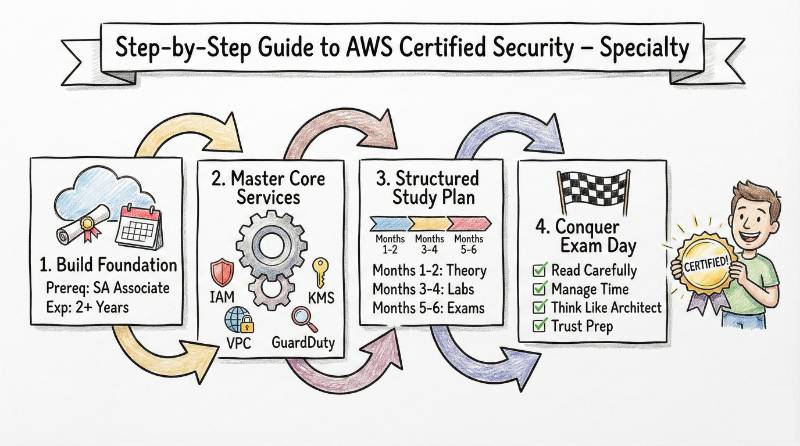
Introduction
In the age of digital transformation, securing cloud environments is more critical than ever. As organizations increasingly move to the cloud, protecting data, managing access, and ensuring the security of cloud infrastructures have become top priorities. The AWS Certified Security – Specialty certification is specifically designed to validate your expertise in securing Amazon Web Services (AWS) environments, making it one of the most respected certifications in cloud security.
Whether you’re a Security Engineer, Cloud Architect, DevSecOps Engineer, or anyone working with AWS, this certification demonstrates your ability to design, implement, and manage security solutions that protect your cloud infrastructure. As cloud security continues to be a high-demand skill, this certification can help boost your career and open doors to new opportunities in the cloud security space.
What is AWS Certified Security – Specialty?
The AWS Certified Security – Specialty certification is a professional-level credential designed for individuals who wish to demonstrate their ability to secure AWS environments. The exam tests skills in securing data, managing identity, and maintaining compliance within AWS. It covers areas such as identity and access management (IAM), data protection, network security, incident response, and monitoring and logging within AWS.
Who Should Take This Certification?
The AWS Certified Security – Specialty certification is best suited for professionals who have hands-on experience with AWS and want to specialize in securing AWS environments. Ideal candidates include:
- Security Engineers
- Cloud Architects
- DevSecOps Engineers
- AWS Cloud Professionals
- Compliance and Risk Managers
If you are responsible for the security of cloud infrastructure and services, this certification will help deepen your knowledge and improve your security practices in AWS.
Skills You’ll Gain
By obtaining the AWS Certified Security – Specialty certification, you will gain proficiency in several key security areas, including:
- Identity and Access Management (IAM): Understanding how to manage roles, policies, and permissions securely.
- Data Protection: Implementing encryption and key management practices using AWS KMS and S3 encryption.
- Network Security: Configuring VPCs, security groups, and network ACLs to protect cloud environments.
- Incident Response: Building processes to respond to and mitigate security incidents using AWS security tools.
- Compliance: Ensuring that your AWS infrastructure adheres to relevant standards like SOC 2, PCI-DSS, and GDPR.
- Monitoring and Logging: Setting up tools like AWS CloudTrail, GuardDuty, and CloudWatch for continuous monitoring of your environment.
Real-World Projects You Should Be Able to Do
Upon completing the certification, you’ll be ready to tackle the following real-world security challenges:
- Design and implement a secure IAM strategy: Manage user roles and permissions, ensuring the right access levels to AWS services.
- Encrypt sensitive data: Apply AWS KMS to encrypt data at rest and in transit, protecting sensitive information in the cloud.
- Configure a secure AWS network: Set up VPCs, subnets, and security groups to ensure secure communication within the cloud environment.
- Respond to security incidents: Utilize AWS tools to identify and mitigate security breaches, and automate incident responses.
- Ensure compliance with industry standards: Implement AWS security best practices and ensure that cloud environments meet compliance requirements.
- Monitor AWS infrastructure: Use CloudTrail, GuardDuty, and CloudWatch to detect anomalies and security threats.
Preparation Plan
7-14 Days (Quick Overview)
- Familiarize yourself with the exam guide and AWS security tools.
- Review IAM, data protection methods, and encryption techniques.
- Focus on AWS services such as KMS, CloudTrail, GuardDuty, and VPC security.
30 Days (Intermediate Plan)
- Dive deeper into incident response and security monitoring tools.
- Study network security in-depth and configure VPCs with appropriate security settings.
- Set up practice labs for IAM management, encryption, and monitoring.
60 Days (Comprehensive Study)
- Create a mock AWS environment and practice securing it by applying IAM policies, encryption, and network security.
- Review security compliance frameworks such as SOC 2 and GDPR.
- Complete hands-on labs with AWS security tools to strengthen your skills.
- Take mock exams to assess your understanding and identify areas for improvement.
Common Mistakes
- Skipping IAM roles and policies: Failing to deeply understand IAM permissions and policies can lead to misconfigurations.
- Overlooking encryption: Not implementing data encryption for sensitive information at rest and in transit is a significant oversight.
- Neglecting security monitoring: Not leveraging AWS tools like CloudTrail and GuardDuty can leave your environment vulnerable.
- Not practicing hands-on: Relying solely on theoretical knowledge can hinder your ability to manage real-world security challenges.
- Ignoring compliance standards: Security measures must align with industry regulations and compliance standards like PCI-DSS and GDPR.
Best Next Certification After This
Once you complete the AWS Certified Security – Specialty, consider the following next steps in your cloud security journey:
- AWS Certified Solutions Architect – Professional: This will broaden your skills in AWS architecture and advanced design principles.
- Certified Cloud Security Professional (CCSP): A cross-platform certification focusing on cloud security across multiple providers, not just AWS.
- AWS Certified Advanced Networking – Specialty: Ideal if you’re looking to specialize in AWS networking and security.
Choose Your Path
After achieving the AWS Certified Security – Specialty, you can explore additional learning paths to further specialize your skills. Below are six learning paths you may choose:
DevOps Learning Path
- Automate the security of cloud operations and build secure CI/CD pipelines.
DevSecOps Learning Path
- Embed security into the DevOps lifecycle to ensure that security practices are integrated from development to deployment.
SRE Learning Path (Site Reliability Engineering)
- Focus on designing secure and reliable systems for production environments in AWS.
AIOps/MLOps Learning Path
- Enhance security with AI-driven operations and deploy machine learning models securely in AWS.
DataOps Learning Path
- Secure data pipelines and manage data security within AWS environments.
FinOps Learning Path
- Learn to manage cloud costs securely while ensuring financial governance and security in AWS.
Role → Recommended Certifications
| Role | Recommended Certifications |
|---|---|
| Security Engineer | AWS Certified Security – Specialty, AWS Solutions Architect |
| Cloud Engineer | AWS Certified Security – Specialty, AWS Developer |
| Platform Engineer | AWS Certified Security – Specialty, AWS SysOps Admin |
| DevSecOps Engineer | AWS Certified Security – Specialty, Certified Kubernetes Security Specialist |
| Data Engineer | AWS Certified Big Data Specialty, AWS Certified Security – Specialty |
| Engineering Manager | AWS Certified Security – Specialty, AWS Solutions Architect |
FAQs (12 Questions)
1. How difficult is the AWS Certified Security – Specialty exam?
The exam is considered challenging. It requires deep knowledge of AWS security services, as well as hands-on experience with cloud infrastructure security.
2. How much time should I allocate for preparation?
Typically, 1-2 months of preparation is recommended, depending on your prior experience with AWS security.
3. What resources should I use to prepare for the exam?
Use AWS documentation, AWS whitepapers, practice exams, and hands-on labs. Training from providers like DevOpsSchool and Cotocus can also be beneficial.
4. Can I take the exam online?
Yes, the exam can be taken online via remote proctoring.
5. What happens if I fail the exam?
You can retake the exam after a 14-day waiting period. Review areas of difficulty before retaking the exam.
6. What are the main topics covered in the exam?
The exam covers IAM, data protection, incident response, network security, and compliance standards.
7. How long is the certification valid?
The certification is valid for three years.
8. How does this certification benefit my career?
It increases your employability in cloud security roles, opening doors to higher-paying, specialized positions in AWS security management.
9. What is the passing score for the exam?
The passing score is 750 out of 1000.
10. What are the most common mistakes candidates make?
Common mistakes include neglecting IAM security, skipping practice exams, and not fully understanding encryption techniques.
11. Can I take this exam without prior AWS experience?
While prior AWS knowledge is recommended, it is not a strict prerequisite. Hands-on practice with AWS services is key.
12. What is the next certification to pursue after this?
Consider pursuing AWS Certified Solutions Architect – Professional, CCSP, or AWS Certified Advanced Networking – Specialty for further career growth.
Next Certifications to Take
Same Track:
- AWS Certified Solutions Architect – Professional
Cross-Track:
- Certified Cloud Security Professional (CCSP)
Leadership Track:
- AWS Certified Advanced Networking – Specialty
Top Institutions Offering AWS Certified Security – Specialty Training
DevOpsSchool
DevOpsSchool offers expert-led training designed to help professionals prepare for the AWS Certified Security – Specialty certification. Their hands-on labs, expert guidance, and mock exams ensure comprehensive exam preparation.
Cotocus
Cotocus provides AWS security training that focuses on both theoretical concepts and hands-on labs. Their course prepares you to implement AWS security best practices and pass the certification exam.
ScmGalaxy
ScmGalaxy offers practical AWS security training, covering topics such as IAM, network security, and incident response. Their training prepares you for real-world security challenges in AWS environments.
BestDevOps
BestDevOps provides flexible, self-paced learning options, combined with instructor-led training. Their AWS security certification courses ensure you understand all aspects of securing cloud environments.

