
Introduction:
Cloud has become the default platform for modern applications, but security risks have also grown at the same speed. Organizations now need engineers who understand how to protect identities, networks, data, and workloads in Azure in a practical, hands-on way.
The Microsoft Azure Security Technologies (AZ-500) certification focuses exactly on these skills. It validates your ability to implement, manage, and monitor security for Azure, multi-cloud, and hybrid environments, which makes it highly valuable for both engineers and managers. Whether you work as a DevOps Engineer, Security Engineer, SRE, Platform Engineer, or Cloud Architect, AZ-500 is one of the most relevant certifications in the current market.
In this guide, you will learn what AZ-500 covers, who should take it, how to prepare, common mistakes to avoid, and how to connect this certification with your broader DevOps, DevSecOps, SRE, AIOps/MLOps, DataOps, and FinOps career path.
What Is Microsoft Azure Security Technologies (AZ-500)?
Microsoft Azure Security Technologies (AZ-500) is a Microsoft Azure security certification that validates your ability to implement, manage, and monitor security controls in Azure. It focuses on identity and access management, platform protection, data and application security, and security operations across cloud and hybrid environments.
You learn how to secure identities with Azure Active Directory, design secure networks, protect workloads, configure encryption, manage keys, and run security operations using tools like Microsoft Defender for Cloud and Microsoft Sentinel. This is not a beginner-level exam; it expects you to already know core Azure services and basic security concepts.
Who Should Take AZ-500?
AZ-500 is best suited for professionals who work with Azure in real environments and have some responsibility for security. Typical roles include:
- DevOps Engineer working with CI/CD pipelines and cloud infrastructure
- Security Engineer responsible for protecting cloud workloads
- Cloud Engineer or Architect managing Azure environments
- SRE or Platform Engineer owning reliability and security controls
- IT Administrator or Systems Engineer moving into cloud security
If you regularly work with Azure resources, identity management, network security, or compliance requirements, AZ-500 will make your profile much stronger in the job market.
Core Skills Covered in AZ-500
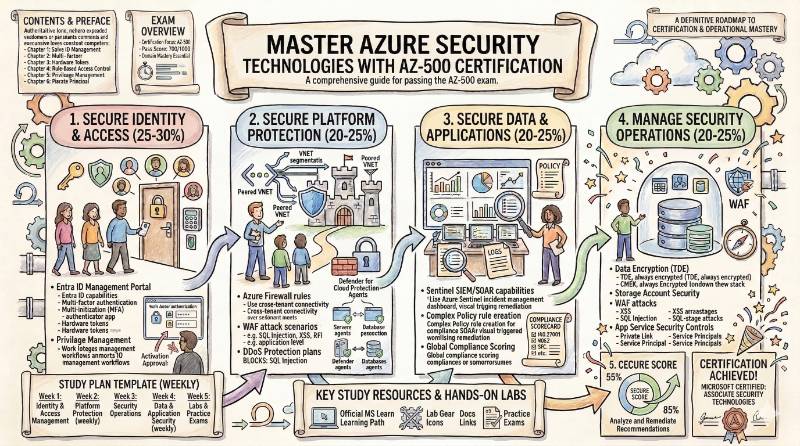
AZ-500 focuses on four major skill domains.
- Identity and access management
- Azure Active Directory and Microsoft Entra ID
- Conditional Access and MFA
- Privileged Identity Management and role-based access control
- Platform protection
- Network security groups, Azure Firewall, Application Gateway
- Secure ingress and egress for workloads
- Host and container security controls
- Data and application security
- Encryption at rest and in transit
- Azure Key Vault, keys, secrets, certificates
- Securing storage accounts and databases
- Security operations
- Microsoft Defender for Cloud configuration
- Microsoft Sentinel for SIEM and threat detection
- Incident response, alerts, dashboards, and secure score management
These skills are directly useful in production environments, not just for passing an exam.
Microsoft Azure Security Technologies (AZ-500)
What It Is
Microsoft Azure Security Technologies (AZ-500) is a role-based certification focused on Azure security engineering. It is aimed at professionals who implement, manage, and monitor security for resources in Azure, multi-cloud, and hybrid environments.
The exam covers identity security, platform protection, data and application security, and security operations, aligned with real-world enterprise use cases.
Who Should Take It
- DevOps Engineers running production workloads on Azure
- Security Engineers responsible for cloud security posture
- Cloud Engineers and Architects designing secure architectures
- SREs and Platform Engineers accountable for reliability and risk
- Engineering Managers overseeing cloud and product security
Skills You Will Gain
- Design and implement identity and access management strategies in Azure AD and Microsoft Entra ID
- Configure secure networking using NSGs, Azure Firewall, Application Gateway, and Front Door
- Protect data using encryption, Key Vault, and secure storage patterns
- Enable and tune Microsoft Defender for Cloud and Microsoft Sentinel for continuous monitoring and threat detection
- Implement security baselines, policies, and compliance controls at scale
Real-World Projects You Should Handle After AZ-500
After completing AZ-500, you should be able to:
- Design and implement secure landing zones for new Azure projects
- Build secure network perimeters using firewalls, gateways, and zero-trust principles
- Configure identity governance, including just-in-time access and privileged access workflows
- Implement end-to-end monitoring and alerting for security incidents using Defender for Cloud and Sentinel
- Run security assessments, reduce security score gaps, and present clear remediation plans to stakeholders
Preparation Plan Options
You can choose your study plan based on your current Azure experience.
7–14 day intensive plan (for experienced Azure users):
- Days 1–2: Identity and access management (Azure AD, RBAC, Conditional Access)
- Days 3–4: Network security (NSG, Firewall, Application Gateway, Front Door)
- Days 5–6: Data and application security (Key Vault, encryption, databases, storage)
- Days 7–10: Microsoft Defender for Cloud and Sentinel, incident response scenarios
- Days 11–14: Practice exams, lab replays, and weak-area revision
30-day structured plan (for intermediate Azure users):
- Weeks 1–2: Fundamentals of Azure core services and security concepts
- Week 3: Deep dive into identity and platform protection
- Week 4: Data security, security operations, labs, and mock exams
60-day relaxed plan (for people new to security):
- Month 1: Azure fundamentals, networking, and core resource management
- Month 2: Security domains, labs, and exam practice with more hands-on projects
Common Mistakes to Avoid
- Jumping into AZ-500 without understanding core Azure services
- Ignoring hands-on labs and relying only on theory or notes
- Underestimating identity and access management, which has major weight in the exam
- Not practicing with Defender for Cloud and Sentinel in real or demo environments
- Skipping practice exams and not reviewing incorrect answers in depth
Best Next Certification After AZ-500
After AZ-500, you can grow in multiple directions depending on your role and interest.
- Same track (Cloud Security / Azure): Azure Architect-level certifications or advanced Azure security specializations
- Cross-track (DevOps / Cloud Engineering): Certifications like Azure DevOps Engineer or cloud-native certifications that combine CI/CD, containers, and security
- Leadership path: Architecture and strategy-oriented certifications that focus on designing secure, scalable cloud systems and leading engineering teams
Choose Your Path: 6 Learning Paths Around AZ-500
You can use AZ-500 as a core building block and combine it with other skills based on your long-term career path.
DevOps Path
Focus on integrating security into CI/CD pipelines, infrastructure as code, and container platforms. AZ-500 helps you design secure Azure environments, while DevOps skills ensure fast, reliable delivery. You become the person who can both ship fast and keep the cloud environment safe.
DevSecOps Path
Here you treat security as a first-class citizen in every step of the software lifecycle. AZ-500 gives you deep understanding of Azure security tools, and DevSecOps practices help you embed checks into pipelines, code scanning, and runtime protection. This is ideal for those who want to own both security architecture and automation.
SRE Path
If you work as an SRE or platform reliability engineer, AZ-500 helps you handle the security side of reliability. You learn how to monitor, respond to, and reduce security risks that can cause outages or incidents. Combining SRE principles with AZ-500 makes you very valuable to product teams that run critical services.
AIOps / MLOps Path
In AIOps and MLOps, you manage intelligent systems and data-intensive pipelines. Once you understand Azure security via AZ-500, you can design secure environments for ML workloads, logging pipelines, and AI services. This is especially important when you work with sensitive or regulated data.
DataOps Path
DataOps focuses on building reliable, secure data pipelines and platforms. AZ-500 helps you protect data at rest and in transit, manage keys, and implement compliance controls around analytics and storage workloads. This is a strong route for Data Engineers and Analytics teams who must maintain trust and compliance.
FinOps Path
FinOps deals with cost optimization and financial visibility in the cloud. With AZ-500, you understand how security decisions impact architecture and cost, such as logging levels, security tools, or redundancy. This combination helps you recommend designs that are both secure and cost-effective.
Role → Recommended Certifications Mapping
This table gives a practical mapping from role to recommended certification directions along with AZ-500.
| Role | How AZ-500 Helps | Recommended Direction After AZ-500 |
|---|---|---|
| DevOps Engineer | Secures CI/CD, infra, and workloads on Azure | Add DevOps-focused cloud certifications and advanced Azure tracks |
| SRE | Strengthens security aspects of reliability and incident response | Move toward architecture and resilience-focused certifications |
| Platform Engineer | Designs secure platform services and shared infrastructure | Combine with scalable architecture or container-focused certifications |
| Cloud Engineer | Validates end-to-end Azure security skills | Pursue broader cloud architecture certifications and multi-cloud tracks |
| Security Engineer | Core role; AZ-500 directly matches daily responsibilities | Continue with advanced cloud security and architecture certifications |
| Data Engineer | Ensures secure data platforms and pipelines | Add data-focused cloud certifications that build on secure foundations |
| FinOps Practitioner | Understands cost impact of security and compliance designs | Blend with cloud financial management and architecture credentials |
| Engineering Manager | Improves decisions on risk, budget, and architecture | Combine with high-level architecture and leadership certifications |
Role-Based Preparation Approaches
Different roles should study AZ-500 with slightly different focus areas.
- DevOps / Platform / SRE
- Focus: Network security, identity, automation of security controls, monitoring and incident response.
- Security Engineer
- Focus: End-to-end security architecture, policies, compliance, Defender for Cloud, and Sentinel.
- Data Engineer / DataOps
- Focus: Data security, Key Vault, encryption, storage, database security, and access controls.
- Engineering Manager
- Focus: Understanding scope, risk, high-level architecture, and how these features affect team processes and cost.
Next Certifications After AZ-500
Based on typical software engineering and cloud career paths, you can think about the next steps in three categories.
Same Track (Security / Azure)
Stay deep in Azure and security-focused cloud engineering. This route is good if you want to be a go-to security expert for Azure workloads.
Cross-Track (DevOps, Data, AI, Multi-cloud)
Here you combine AZ-500 with skills from DevOps, Data platforms, AI/ML, or other major cloud providers. This is strong for engineers who work in complex, multi-cloud or hybrid environments.
Leadership Track (Architecture and Management)
If you are a manager or aspiring architect, connect AZ-500 with architecture and strategy certifications that focus on designing secure systems, managing trade-offs, and guiding teams.
Top Training Institutions for AZ-500
Several institutions can support you with training and certification preparation for Microsoft Azure Security Technologies (AZ-500). The descriptions below focus on their strengths for this area.
DevOpsSchool
DevOpsSchool offers structured, hands-on training programs that align directly with real job requirements across cloud and DevOps roles. Their AZ-500 training typically includes live instructor-led sessions, labs, real-world projects, and lifetime access to learning materials and support, which is very useful for busy engineers and managers.
Cotocus
Cotocus is a consulting and training organization focused on modern DevOps and cloud skills. They usually emphasize practical learning through case studies, guided labs, and project-based assignments that help you connect AZ-500 topics with real enterprise scenarios.
Scmgalaxy
Scmgalaxy provides training across DevOps, CI/CD, source control, and cloud technologies. Their programs often mix tooling, processes, and cloud platform content, helping engineers understand how AZ-500 concepts integrate with pipelines and configuration management practices.
BestDevOps
BestDevOps focuses on curating DevOps and cloud resources, training, and knowledge sharing. For AZ-500 learners, this can be a useful ecosystem to discover complementary skills in automation, orchestration, and cloud-native engineering alongside security.
devsecopsschool.com
devsecopsschool.com is centered on DevSecOps principles, secure development, and continuous security. When you combine AZ-500 with their style of training, you can learn how to embed Azure security best practices into CI/CD pipelines, code analysis, and automated checks.
sreschool.com
sreschool.com focuses on Site Reliability Engineering and production operations. With an SRE mindset, AZ-500 becomes a tool to ensure both reliability and security, helping you build systems that are observable, resilient, and well-protected against threats.
aiopsschool.com
aiopsschool.com works at the intersection of operations and AI-driven automation. When paired with AZ-500, this path helps you design secure monitoring and incident response systems, where telemetry and security signals feed intelligent automation in the cloud.
dataopsschool.com
dataopsschool.com focuses on DataOps, analytics pipelines, and data lifecycle practices. Combining their programs with AZ-500 helps you build secure data pipelines, where governance, encryption, and access controls are designed in from day one.
finopsschool.com
finopsschool.com addresses financial operations and cloud cost management. When you learn AZ-500 alongside FinOps concepts, you gain the ability to design architectures that are both secure and cost-aware, balancing risk, performance, and spending.
FAQs on Microsoft Azure Security Technologies (AZ-500)
1. Is AZ-500 difficult to pass?
AZ-500 is considered an intermediate to advanced exam because it expects good knowledge of Azure services and practical security skills. If you have hands-on experience and follow a focused study plan, it is challenging but achievable.
2. How long does it take to prepare for AZ-500?
Preparation time depends on your background. Many working engineers need between a few weeks and a couple of months, with more time required if you are new to Azure or security. Choosing a 14, 30, or 60-day plan is a good way to manage this.
3. Do I need Azure Fundamentals before AZ-500?
A fundamental-level understanding of Azure is strongly recommended even if it is not always a formal prerequisite. You should be comfortable with core services like compute, storage, networking, and identity before starting serious AZ-500 study.
4. Is AZ-500 good for DevOps Engineers?
Yes, AZ-500 is very valuable for DevOps Engineers who work on Azure. It helps you design secure infrastructure, integrate security into pipelines, and work more confidently with security teams.
5. Can SREs and Platform Engineers benefit from AZ-500?
SREs and Platform Engineers benefit a lot because they often own reliability, observability, and platform-level design. AZ-500 adds a strong security layer to their existing skills.
6. What are the main topics covered in AZ-500?
The main domains are identity and access management, platform protection, data and application security, and security operations. These map closely to real responsibilities in cloud security roles.
7. Is AZ-500 useful outside Azure-only environments?
Yes, because many concepts like identity governance, network protection, encryption, and incident response are similar across clouds. Also, tools like Microsoft Defender for Cloud can integrate multi-cloud environments.
8. Does AZ-500 help with career growth?
AZ-500 signals that you can take ownership of security in Azure environments, which is highly valued by employers. It can help you move into more senior roles or specialize in cloud security.
9. What common mistakes do candidates make while preparing?
Typical mistakes are skipping hands-on practice, underestimating identity and access management, ignoring security operations, and not reviewing failed questions from practice tests. A balanced approach with theory and labs works best.
10. Can software engineers with a development background clear AZ-500?
Yes, many software engineers transition into DevSecOps, cloud security, or platform roles through AZ-500. A development background helps you understand how applications interact with cloud services and security controls.
11. What is the best sequence for learning around AZ-500?
A practical sequence is: cloud fundamentals, Azure services, core security concepts, then AZ-500-focused topics and labs. After that, you can extend into DevOps, architecture, or leadership certifications depending on your path.
12. Is AZ-500 worth it for managers?
For managers and leads, AZ-500 improves conversations with security, platform, and product teams. It helps you make better decisions on risk, budgeting, and design trade-offs in cloud projects.
General FAQs on Microsoft Azure Security Technologies (AZ-500)
Exam Logistics and Requirements
Q1: What is the format of the AZ-500 exam?
The exam typically includes 40-60 questions. You’ll see multiple-choice questions, case studies, and sometimes performance-based labs where you configure actual Azure resources. You get 150 minutes to complete it .
Q2: How much does the AZ-500 exam cost?
In India, the exam costs approximately ₹4,800 plus taxes. Pricing varies by region, so check the official Microsoft Certification website for your local rate .
Q3: Do I need to renew this certification?
Yes, AZ-500 is valid for one year. Microsoft offers free online renewal through an annual assessment. You can retake it as soon as you’re eligible again .
Q4: Can I take the exam from home?
Yes, Microsoft offers online proctored exams. You’ll need a quiet room, stable internet, and a webcam. A proctor monitors you throughout the test .
Q5: What happens if my internet disconnects during the online exam?
Stay calm and try to reconnect immediately. Most proctors will wait a few minutes. If you can’t reconnect, contact customer support—they usually offer a free reschedule .
Prerequisites and Background
Q6: Do I need programming experience for AZ-500?
Not exactly. You should understand basic PowerShell and Azure CLI commands. Reading JSON for Azure Policies helps, but you don’t need to be a developer .
Q7: Is networking knowledge necessary?
Absolutely. You must understand subnets, IP addressing, firewalls, and basic routing. Without networking fundamentals, securing Azure becomes extremely difficult .
Q8: Can a fresher take this certification?
Technically yes, but practically no. Microsoft recommends at least one year of Azure experience. Without hands-on work, the concepts feel abstract and hard to apply .
Q9: Which certification should I take before AZ-500?
Most professionals take AZ-900 (Azure Fundamentals) then AZ-104 (Azure Administrator) before attempting AZ-500. This builds necessary foundations step by step .
Q10: Is AWS or Google Cloud knowledge transferable?
Partially. Security concepts transfer well, but Azure-specific services like Microsoft Entra ID and Defender for Cloud require dedicated study. Don’t assume you already know it .
Study and Preparation
Q11: Can I pass using only video courses?
Videos help understand concepts, but you absolutely need hands-on practice. Build labs. Break things. Fix them. That’s how you really learn Azure security .
Q12: How many practice tests should I take?
Take at least three full-length practice exams. More importantly, review every question you miss. Understand why the correct answer is right and why others are wrong .
Conclusion
Microsoft Azure Security Technologies (AZ-500) is one of the most practical certifications for engineers and managers who work with Azure-based systems and want to take cloud security seriously. It gives you a clear, structured way to build skills in identity, network protection, data security, and security operations, all of which are in high demand across industries.
By following a focused preparation plan, choosing the right learning path, and combining AZ-500 with complementary certifications for your role, you can significantly strengthen your profile as a DevOps, Security, SRE, Data, or Cloud professional in India and globally.

