
Introduction
In today’s fast-moving tech world, the cloud is no longer just a trend—it is the standard. Whether you are an engineer building applications or a manager overseeing complex systems, understanding cloud architecture is essential for staying competitive. Among the various credentials available, the AWS Certified Solutions Architect – Associate (SAA-C03) stands out as the most respected and versatile certification for professionals globally.
This certification is not about memorizing a list of services; it is about learning how to solve real-world business problems using the AWS Well-Architected Framework. It bridges the gap between basic technical knowledge and the high-level strategic thinking required to design secure, resilient, and cost-effective systems. For those in India and across the global market, achieving this status is a clear signal to the industry that you possess the expertise to handle modern infrastructure at scale.
Understanding the AWS Certification Landscape
Before we dive deep into the Solutions Architect role, it is important to see where it fits. AWS offers a variety of tracks. For a working professional, choosing the right path saves time and money.
Table: Overview of Key AWS Certifications
| Track | Level | Who it’s for | Prerequisites | Skills Covered | Recommended Order |
| Foundational | Beginner | Non-tech & Newcomers | None | Cloud Basics, Billing, Security | 1st |
| Architect | Associate | Engineers & Architects | None (Basic IT helpful) | VPC, EC2, S3, RDS, IAM, SQS | 2nd |
| Operations | Associate | SysAdmins & Ops | 1 year Ops exp | Deployment, Management, Monitoring | 3rd (Optional) |
| Developer | Associate | Software Developers | SDK knowledge | CI/CD, Serverless, APIs, DBs | 3rd (Optional) |
| Architect | Professional | Senior Architects | Associate level exp | Complex Org Design, Migrations | 4th |
| DevOps | Professional | DevOps/SREs | Associate level exp | Automation, Governance, Resilience | 4th |
| Security | Specialty | Security Professionals | Strong AWS Core | Data Protection, Incident Response | 5th |
About the Certification: AWS Certified Solutions Architect – Associate
What it is This certification validates your ability to design and deploy secure and robust applications on AWS technologies. It focuses on using the AWS Well-Architected Framework to build high-performing and cost-effective systems.
Who should take it
- Software Engineers wanting to understand the infrastructure where their code runs.
- System Administrators moving from on-premise to the cloud.
- Engineering Managers who need to make informed technical and cost-related decisions.
- Solution Architects looking to validate their professional expertise.
Skills you’ll gain
- Designing Secure Architectures using IAM and encryption.
- Building Resilient Systems with high availability and fault tolerance.
- Optimizing High-Performance Architectures using caching and auto-scaling.
- Implementing Cost-Optimized Solutions by choosing the right storage and compute tiers.
- Hands-on experience with Networking (VPC) and Database Management.
Real-world projects you should be able to do after it
- Build a multi-tier web application with a load balancer and auto-scaling.
- Design a disaster recovery plan using cross-region replication.
- Set up a secure private network (VPC) with public and private subnets.
- Migrate a legacy database to a managed AWS RDS instance.
- Configure a serverless data processing pipeline using Lambda and S3.
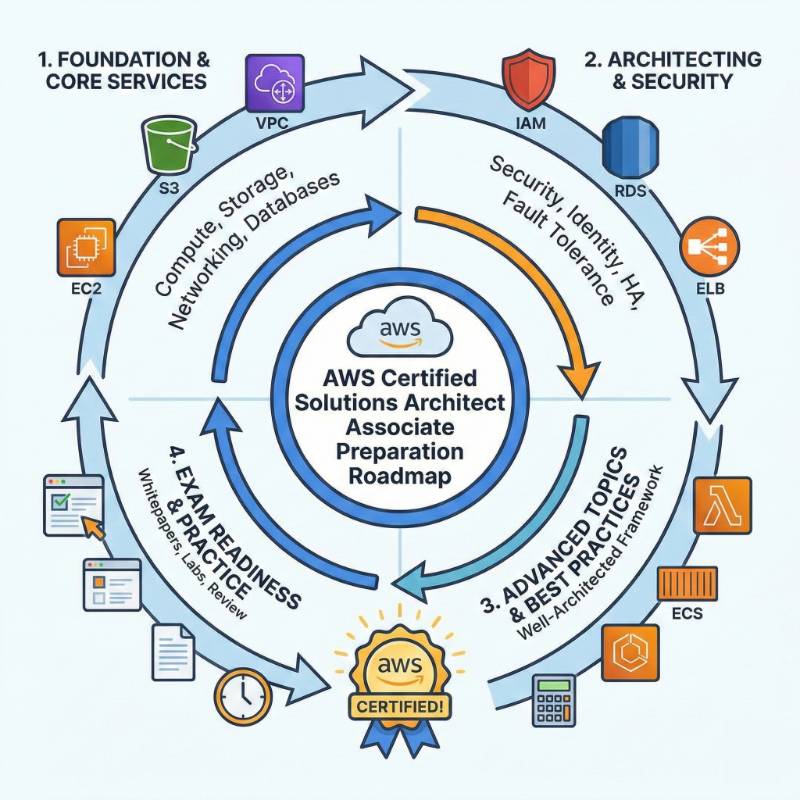
Preparation Plan
- 7–14 Days (The Expert Sprint):
Focus on the exam guide and high-level whitepapers. Take 3-5 full-length mock exams. Recommended if you already use AWS daily. - 30 Days (The Professional Path):
Spend 1 hour daily on core services (VPC, EC2, S3, RDS). Spend weekends on hands-on labs. This is the sweet spot for most working engineers. - 60 Days (The Deep Dive):
Ideal for those new to cloud. Dedicate the first month to foundational labs and the second month to architectural patterns and practice tests.
Common Mistakes
- Underestimating Networking: Many fail because they don’t fully grasp how VPCs and routing work.
- Memorizing instead of Doing: AWS tests “what would you do if…” scenarios. Labs are essential.
- Ignoring Cost: You must know which service is cheaper, not just which one works.
- Skipping the Well-Architected Framework: This framework is the “bible” for the exam questions.
Best next certification after this:
The AWS Certified Solutions Architect – Professional is the natural evolution for architects. However, if you are moving into automation, the DevOps Engineer – Professional is equally valuable.
Choose Your Path: 6 Specialized Learning Tracks
Cloud expertise is not one-size-fits-all. Depending on your career goals, you should align your AWS learning with a specific domain.
1. DevOps Path
This path focuses on speed and automation. After your Associate cert, you dive into CI/CD pipelines, Infrastructure as Code (Terraform/CloudFormation), and automated testing. You ensure that code moves from a developer’s machine to production without human friction.
2. DevSecOps Path
Security is everyone’s job. This track emphasizes “shifting security left.” You learn how to automate vulnerability scanning, manage secrets securely, and implement compliance-as-code within your AWS environment.
3. SRE (Site Reliability Engineering) Path
SREs are the guardians of production. Here, you focus on observability, monitoring (CloudWatch), and building self-healing systems. You learn to manage error budgets and ensure the system stays up even when things go wrong.
4. AIOps / MLOps Path
The future of operations involves AI. This path focuses on using Machine Learning to predict outages and automate routine tasks. You will work with services like SageMaker and specialized AI/ML tools to manage models at scale.
5. DataOps Path
Data is the lifeblood of modern apps. In this track, you master data pipelines, data lakes (S3 + Lake Formation), and automated data governance. You treat data flows with the same rigor as application code.
6. FinOps Path
Cloud costs can spiral out of control. The FinOps path teaches you to bridge the gap between finance and engineering. You learn automated cost-saving strategies, tagging policies, and how to read the AWS bill like a pro.
Role → Recommended Certifications Mapping
To help you plan your journey, here is a mapping of common roles to the certifications that provide the most impact.
- DevOps Engineer: Solutions Architect Associate → SysOps Associate → DevOps Professional.
- SRE: Solutions Architect Associate → SysOps Associate → Security Specialty.
- Platform Engineer: Solutions Architect Associate → DevOps Professional → Certified Kubernetes Administrator (CKA).
- Cloud Engineer: Cloud Practitioner → Solutions Architect Associate → SysOps Associate.
- Security Engineer: Solutions Architect Associate → Security Specialty.
- Data Engineer: Solutions Architect Associate → Data Engineer Associate.
- FinOps Practitioner: Cloud Practitioner → Solutions Architect Associate → FinOps Certified Practitioner.
- Engineering Manager: Cloud Practitioner → Solutions Architect Associate.
Next Certifications to Take
Once you have cleared the Associate level, you have three main ways to grow:
- Same Track (Deepening Skills): AWS Certified Solutions Architect – Professional. This proves you can handle enterprise-scale complexity across multiple accounts and regions.
- Cross-Track (Broadening Skills): Certified Kubernetes Administrator (CKA). Since many AWS workloads run on EKS, knowing Kubernetes is a massive career booster.
- Leadership (Strategic Growth): AWS Certified Cloud Practitioner (if skipped) or Certified Information Systems Security Professional (CISSP) for a security-focused leadership role.
Top Institutions for Training and Certification
Finding the right mentor makes a world of difference. These institutions provide specialized training to help you clear the AWS Certified Solutions Architect – Associate exam with hands-on projects.
- DevOpsSchool:
A premier institution focusing on practical, tool-based training. They integrate 50+ DevOps tools into the AWS curriculum, making it perfect for engineers who need real-world skills. - Cotocus:
Known for their boutique training approach, focusing on intensive boot camps and personalized mentorship for senior engineers and architects. - Scmgalaxy:
A vast resource for technical content and training. They specialize in the intersection of software configuration management and cloud architecture. - BestDevOps:
Focuses on providing streamlined, project-oriented courses that help working professionals transition into high-paying cloud roles quickly. - devsecopsschool.com:
The go-to place for security-focused cloud training. They teach you how to bake security into every layer of your AWS architecture. - sreschool.com:
Specializes in reliability and observability. Their training covers how to run production systems on AWS with zero downtime. - aiopsschool.com:
Leads the way in modern operations, teaching engineers how to use artificial intelligence to manage and monitor AWS environments. - dataopsschool.com:
Ideal for those managing data-heavy applications. They provide deep dives into AWS data services and pipeline automation. - finopsschool.com:
Focuses exclusively on the financial side of the cloud, teaching you how to optimize costs and manage cloud budgets effectively.
FAQs: AWS Certified Solutions Architect – Associate
1. How difficult is the SAA-C03 exam compared to others?
It is a step up from the Cloud Practitioner but manageable for anyone with basic IT knowledge. It focuses more on architectural patterns than on simple definitions.
2. How much time do I need to prepare if I have a full-time job?
Most professionals find that 30 to 45 days, with 1-2 hours of study per day, is sufficient to pass comfortably.
3. Are there any mandatory prerequisites for this exam?
No, AWS has removed the requirement to have a foundational cert first. You can go straight for the Associate level.
4. What is the recommended sequence for AWS certifications?
I suggest starting with the Solutions Architect Associate as it gives the broadest view. Then move to the Developer or SysOps Associate based on your role.
5. Is this certification still valuable in today’s market?
Absolutely. It remains the most requested certification by recruiters and managers globally for cloud-related roles.
6. Does the exam involve coding or programming?
No. While you should understand JSON/YAML for policies and configuration, you do not need to write application code like Python or Java to pass.
7. How long is the certification valid?
It is valid for three years. You can recertify by taking the exam again or by passing the Professional level exam.
8. Can this certification help me get a job in India and abroad?
Yes. It is a globally recognized credential. In India, it is a key requirement for most Tier-1 IT companies and startups.
9. What is the passing score for the exam?
You need a minimum score of 720 out of 1000 to pass.
10. Can I take the exam from my home?
Yes, AWS offers online proctored exams through Pearson VUE, allowing you to take it from your home or office.
11. What happens if I fail the exam?
You must wait 14 days before you can retake the exam. You will have to pay the full exam fee for each attempt.
12. Does it cover new services like AI and Serverless?
Yes, the SAA-C03 version includes questions on serverless architecture (Lambda, SQS) and newer AWS best practices for data and AI.
Conclusion
Taking the step to become an AWS Certified Solutions Architect – Associate is more than just adding a badge to your profile; it is about shifting your mindset from managing servers to designing solutions. In my years of navigating the shifts from on-premise data centers to the current cloud-native era, I have found that the ability to architect for resilience and cost is what truly separates a senior engineer from the rest.
The journey ahead requires consistency, but the rewards—in terms of both career mobility and technical confidence—are immense. Whether you are aiming for a lead role in DevOps, moving into FinOps to manage cloud economics, or ensuring system reliability as an SRE, this certification provides the foundational logic you need to succeed.

