
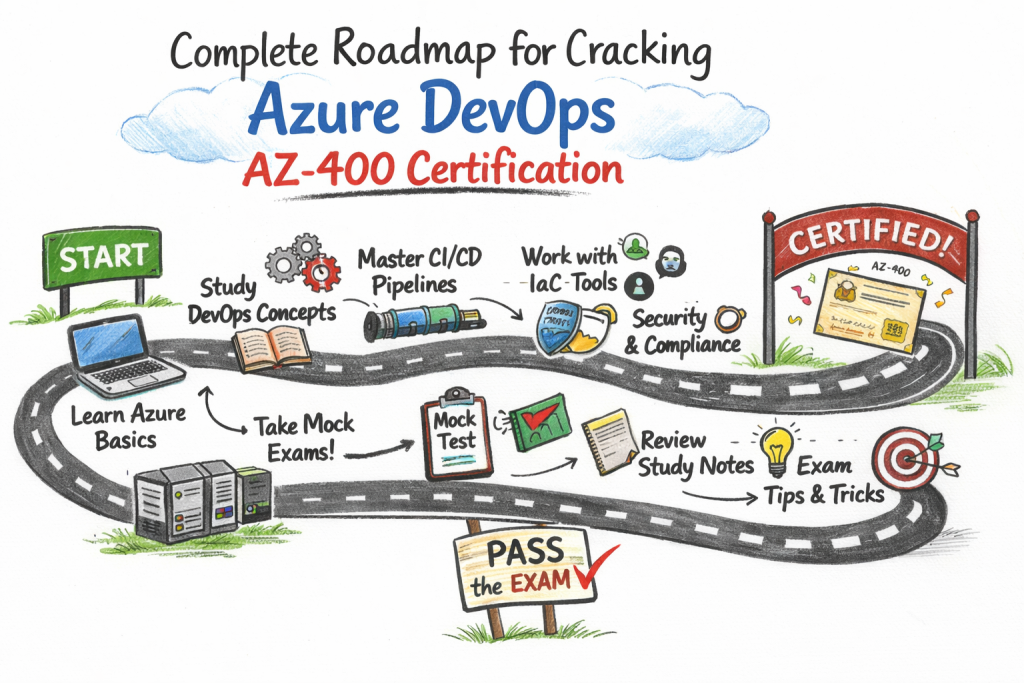
Introduction
The Azure DevOps Engineer Expert (AZ-400) certification is one of the most powerful ways to prove that you can design, automate, and manage the complete software delivery lifecycle on Microsoft Azure. It is built for professionals who work at the intersection of development, operations, and cloud, and who are responsible for building secure, reliable, and scalable delivery pipelines. For working engineers, software developers, SREs, and managers in India and across the globe, this certification has become a key differentiator for landing better roles, leading modern DevOps initiatives, and staying relevant in an increasingly cloud-first world.
What Is the AZ-400 Certification?
The Microsoft Certified: Azure DevOps Engineer Expert (AZ-400) is an expert-level certification from Microsoft that validates your ability to combine people, processes, and technology to deliver software continuously and reliably on Azure.
It is designed for professionals who work across both development and operations — engineers who understand how to build automation pipelines, manage infrastructure as code, and implement security and compliance into the delivery lifecycle.
Certification Details at a Glance:
| Field | Details |
|---|---|
| Certification Name | Azure DevOps Engineer Expert (AZ-400) |
| Track | Expert |
| Level | Expert |
| Who It’s For | DevOps Engineers, Cloud Engineers, SREs, Platform Engineers |
| Prerequisites | AZ-104 (Azure Administrator) or AZ-204 (Azure Developer) |
| Skills Covered | CI/CD, IaC, Source Control, Security, Monitoring, SRE |
| Recommended Order | After AZ-104 or AZ-204 |
| Official URL | Microsoft Certified: Azure DevOps Engineer Expert (AZ-400) |
Who Should Take This Certification?
This certification is built for professionals who are already working in the cloud and want to take their DevOps skills to the expert level.
Best fit for:
- DevOps Engineers managing Azure pipelines and releases
- Cloud Engineers automating infrastructure on Azure
- Site Reliability Engineers (SREs) building resilient systems
- Platform Engineers designing internal developer platforms
- Software Engineers moving into DevOps roles
- Engineering Managers who want technical credibility and team leadership
- Anyone holding AZ-104 or AZ-204 looking for their next step
Skills You Will Gain
After clearing the AZ-400, you will have hands-on, proven skills across the entire DevOps toolchain on Azure.
Core skills covered:
- Design and implement processes and communications (10–15%)
- Design and implement a source control strategy (10–15%)
- Design and implement build and release pipelines (50–55%)
- Develop a security and compliance plan (10–15%)
- Implement an instrumentation strategy (5–10%)
Specific technical skills:
- CI/CD pipeline design using Azure Pipelines and GitHub Actions
- Infrastructure as Code using ARM templates, Bicep, and Terraform
- Source control management with Git and GitHub Flow
- Monitoring, logging, and feedback loops using Azure Monitor
- Security, governance, and compliance integration into DevOps
Real-World Projects You Should Be Able to Do After This
Clearing the AZ-400 is not just about passing an exam — it prepares you to deliver real engineering outcomes.
Projects you should be able to execute:
- Build a fully automated CI/CD pipeline using Azure Pipelines with multi-stage deployments
- Set up GitHub Actions workflows connected to Azure services
- Deploy cloud infrastructure using Terraform or Bicep via automated pipelines
- Configure Azure Monitor dashboards and alerting for production systems
- Implement branch protection policies and pull request workflows using GitHub
- Integrate security scanning and compliance gates inside a CI/CD pipeline
- Set up blue-green or canary deployment strategies for zero-downtime releases
- Create and manage Azure Boards with full Agile/Scrum sprint tracking
Preparation Plan
7–14 Day Fast Track (Experienced Engineers)
This plan suits professionals already working with Azure DevOps or GitHub daily.
- Day 1–2: Review exam objectives and identify weak areas using the official skills outline
- Day 3–5: Focus on pipelines — Azure Pipelines, GitHub Actions, multi-stage YAML
- Day 6–8: Practice IaC with Bicep, ARM, and Terraform basics
- Day 9–11: Cover security, compliance, and monitoring topics
- Day 12–14: Full-length practice tests and hands-on labs
30-Day Standard Plan (Working Professionals)
Ideal for engineers with Azure experience but limited DevOps depth.
- Week 1: Foundation — source control strategy, Azure Boards, GitHub Flow
- Week 2: CI/CD deep dive — build pipelines, test automation, release strategies
- Week 3: IaC, security scanning, compliance gates, and artifact management
- Week 4: Monitoring, SRE fundamentals, practice exams, and gap filling
60-Day Comprehensive Plan (Career Switchers)
Best for those transitioning from non-DevOps roles or clearing prerequisites simultaneously.
- Month 1: Complete AZ-104 or AZ-204 (if not already certified), then start AZ-400 fundamentals
- Month 2: Deep dive into all exam domains, hands-on Azure labs, mock exams, and mentorship sessions
Common Mistakes to Avoid
Many candidates fail the AZ-400 not due to lack of knowledge, but due to avoidable preparation mistakes.
Watch out for these pitfalls:
- Skipping prerequisites — attempting AZ-400 without AZ-104 or AZ-204 experience leads to significant knowledge gaps
- Only studying theory without hands-on lab practice — the exam includes performance-based questions
- Ignoring the security and compliance domain, which many engineers find dry but carries exam weight
- Not practicing YAML pipeline syntax — most pipeline questions are YAML-based, not GUI-based
- Underestimating the IaC section — Bicep and Terraform are both heavily tested
- Memorizing answers instead of understanding concepts — Microsoft frequently updates question pools
- Not timing yourself during practice tests — time management is critical in a 40–60 question exam
Best Next Certification After AZ-400
After clearing the AZ-400, your best move depends on the direction you want to grow. Three strong options are:
- Same Track: Microsoft Certified: Azure Solutions Architect Expert (AZ-305) — expands your cloud design skills
- Cross-Track: Certified Kubernetes Administrator (CKA) — adds container orchestration depth to your DevOps profile
- Leadership Track: DevOps Institute DevOps Leader (DOL) — builds your ability to lead teams, culture, and transformation at scale
Choose Your Path — 6 Learning Paths After AZ-400
The AZ-400 is a strong foundation, but where you go next defines your career. Here are six clear paths:
1. DevOps Path
Focus on deepening Azure DevOps, multi-cloud pipelines, and platform engineering. Follow AZ-400 with AZ-305 and then Kubernetes (CKA/CKAD) to become a complete DevOps architect.
2. DevSecOps Path
Shift left on security. Combine your AZ-400 skills with Certified DevSecOps Professional (CDP) training from DevSecOpsSchool. Learn to embed security gates, SAST, DAST, and compliance as code inside every pipeline.
3. SRE Path
Transition from pipeline management to system reliability. Add SRE fundamentals from SRESchool, master error budgets, SLOs, SLAs, chaos engineering, and observability to move into a dedicated SRE role.
4. AIOps / MLOps Path
Combine your Azure DevOps knowledge with AI operations. Study MLOps practices from AIOpsSchool, learn to build and manage ML pipelines, model registries, and automated retraining workflows on Azure ML.
5. DataOps Path
Apply DevOps principles to data engineering and analytics pipelines. Learn from DataOpsSchool to automate data ingestion, transformation, testing, and deployment — a fast-growing career niche.
6. FinOps Path
Use your cloud expertise to optimize cost. FinOpsSchool offers training to help engineers understand cloud financial management, budgets, cost allocation, and FinOps frameworks — especially valuable for architects and managers.
Role → Recommended Certifications Mapping
| Role | Recommended Certifications |
|---|---|
| DevOps Engineer | AZ-400 → AZ-305 → CKA |
| SRE | AZ-400 → SRE Foundation → CKA |
| Platform Engineer | AZ-400 → CKA → AZ-305 |
| Cloud Engineer | AZ-104 → AZ-400 → AZ-305 |
| Security Engineer | AZ-400 → DevSecOps CDP → AZ-500 |
| Data Engineer | AZ-400 → DP-203 → DataOps Certification |
| FinOps Practitioner | AZ-400 → FinOps Foundation Certified Practitioner |
| Engineering Manager | AZ-400 → DevOps Leader (DOL) → AZ-305 |
Top Training Institutions for AZ-400
When choosing a training partner, look for one that combines curriculum depth, hands-on labs, and mentorship. These institutions are well recognized in the DevOps and cloud training space:
DevOpsSchool —
One of the most comprehensive DevOps training platforms available. DevOpsSchool offers structured AZ-400 training with real-world labs, expert mentors, and a learning path that covers all exam domains in depth. Highly recommended as your primary training destination. Visit: DevOpsSchool
Cotocus —
A trusted training and consulting firm offering instructor-led DevOps and Azure training programs. Cotocus provides both online and corporate training with strong practical coverage, making it a solid choice for team upskilling.
Scmgalaxy —
Focused on SCM, DevOps, and automation tooling, Scmgalaxy brings deep technical expertise to its training programs. Particularly strong for engineers who want a tools-first, hands-on approach to AZ-400 preparation.
BestDevOps —
A platform dedicated to DevOps certification training with curated content, practice labs, and career guidance. BestDevOps is well suited for professionals looking for structured, self-paced learning options.
DevSecOpsSchool—
For AZ-400 candidates who want to strengthen the security and compliance domain, DevSecOpsSchool is the go-to resource, offering specialized DevSecOps training that complements the AZ-400 curriculum.
SRESchool —
If your AZ-400 goal is to grow into an SRE role, SRESchool offers dedicated SRE training that pairs perfectly with the instrumentation and reliability engineering topics covered in AZ-400.
AIOpsSchool —
For engineers who plan to follow the AIOps/MLOps path after AZ-400, AIOpsSchool provides foundational and advanced training in AI-driven operations and MLOps practices.
DataOpsSchool —
Ideal for data engineers who want to apply DevOps practices to data pipelines. DataOpsSchool bridges the gap between AZ-400 concepts and modern DataOps workflows.
FinOpsSchool —
For cloud engineers and architects focused on cost optimization, FinOpsSchool delivers targeted FinOps training aligned with the FinOps Foundation framework.
FAQs on Azure DevOps Engineer Expert (AZ-400)
1. What is the AZ-400 certification?
The AZ-400 is Microsoft’s expert-level certification for DevOps engineers. It validates your ability to design and implement DevOps practices — including CI/CD, IaC, source control, security, and monitoring — on the Microsoft Azure platform.
2. Who should pursue the AZ-400?
Any engineer or architect already working with Azure who wants to formalize their DevOps expertise. It is also a strong choice for managers who want to lead DevOps transformation with technical credibility.
3. What are the prerequisites for AZ-400?
You must hold either the Microsoft Certified: Azure Administrator Associate (AZ-104) or Microsoft Certified: Azure Developer Associate (AZ-204) before attempting the AZ-400.
4. How difficult is the AZ-400 exam?
It is one of Microsoft’s harder certifications. The exam is expert-level, covers a broad range of topics, and includes performance-based questions. Candidates without hands-on Azure DevOps experience often struggle. Proper lab practice is non-negotiable.
5. How long does it take to prepare for AZ-400?
Experienced DevOps engineers can be ready in 2–3 weeks with focused study. For those newer to Azure DevOps, a 30–60 day preparation plan is more realistic and effective.
6. What is the exam format?
The exam has 40–60 questions including multiple-choice, drag-and-drop, and case study formats. It measures skills across five domains with build and release pipelines carrying the highest weight at 50–55%.
7. What salary can I expect after AZ-400?
Certified Azure DevOps Engineers typically command salaries ranging from $132,000 to $201,000 annually in global markets, depending on experience and location. In India, it significantly improves compensation bands and opens doors to MNC and global remote roles.
8. Is coding knowledge required for AZ-400?
Yes, practical coding knowledge is required. You should be comfortable with PowerShell, Python, or Bash for automation, and you need solid understanding of YAML for pipeline configuration.
FAQs on Difficulty, Time, Prerequisites, Sequence, Value, and Career Outcomes
9. Is AZ-400 harder than AZ-104 or AZ-204?
Yes. AZ-400 is an expert-level exam while AZ-104 and AZ-204 are associate-level. It requires broader knowledge, hands-on lab experience, and the ability to make architectural decisions — not just follow procedures.
10. Can I attempt AZ-400 without completing AZ-104 or AZ-204?
No. Microsoft requires at least one of these two associate certifications as an active prerequisite. Attempting AZ-400 without this foundation will result in significant knowledge gaps during the exam.
11. What is the best sequence — AZ-104 first or AZ-204 first?
If you come from an operations or admin background, take AZ-104 first. If you come from a development background, take AZ-204 first. Both lead equally to AZ-400. Choose based on where your current experience is stronger.
12. How much does the AZ-400 exam cost?
The standard exam fee is approximately USD $165, though pricing varies by country. Microsoft offers discounts for students and provides vouchers through official learning programs.
13. How many attempts are allowed for AZ-400?
Microsoft allows multiple attempts. If you fail the first time, you must wait 24 hours. Subsequent retakes require a 14-day waiting period. There is no limit on total attempts within the certification validity window.
14. How long is the AZ-400 certification valid?
Microsoft certifications at expert level are valid for one year and must be renewed annually through a free online assessment on Microsoft Learn, keeping your credential always current.
15. What career roles open up after AZ-400?
The certification positions you for roles including Azure DevOps Engineer, Release Manager, Automation Engineer, Platform Engineer, Cloud Architect, and Site Reliability Engineer — all high-demand, well-compensated positions globally.
16. Is the AZ-400 worth it for Indian engineers specifically?
Absolutely. Azure is the dominant cloud platform in Indian enterprises and MNCs. The AZ-400 is one of the certifications that directly translates into salary hikes, better project assignments, and global remote job opportunities.
17. What tools should I be hands-on with before taking AZ-400?
You should be comfortable with Azure DevOps (Boards, Repos, Pipelines, Artifacts, Test Plans), GitHub, GitHub Actions, Terraform or Bicep, Azure Monitor, and at least one scripting language like PowerShell or Python.
18. Can a software engineer with no cloud experience take AZ-400?
Not directly. You need to first build Azure fundamentals through AZ-900 and then earn either AZ-104 or AZ-204. Skipping these steps almost always leads to failing the AZ-400.
19. Does AZ-400 cover Kubernetes?
Kubernetes basics are touched upon in the context of Azure Kubernetes Service (AKS) and container-based deployments in pipelines. For deep Kubernetes expertise, follow up with a dedicated CKA certification after AZ-400.
20. What is the value of AZ-400 compared to AWS or GCP DevOps certifications?
All three are valuable, but AZ-400 is the deepest and most comprehensive DevOps-specific expert certification in the Microsoft ecosystem. If your organization is Azure-first, AZ-400 is the single highest-value investment you can make in your certification portfolio.
Conclusion
The Azure DevOps Engineer Expert (AZ-400) is not just a certification — it is a career accelerator. It validates that you can operate at the intersection of development, operations, security, and reliability on one of the world’s most widely adopted cloud platforms. Whether you are an engineer looking to move up, a manager wanting technical depth, or a software developer transitioning to DevOps, the AZ-400 gives you the structured knowledge and market credibility to grow faster. Start with your prerequisite, build hands-on lab experience, choose the right training partner from institutions like DevOpsSchool, and take this certification with confidence. Your Azure DevOps career starts here.

