
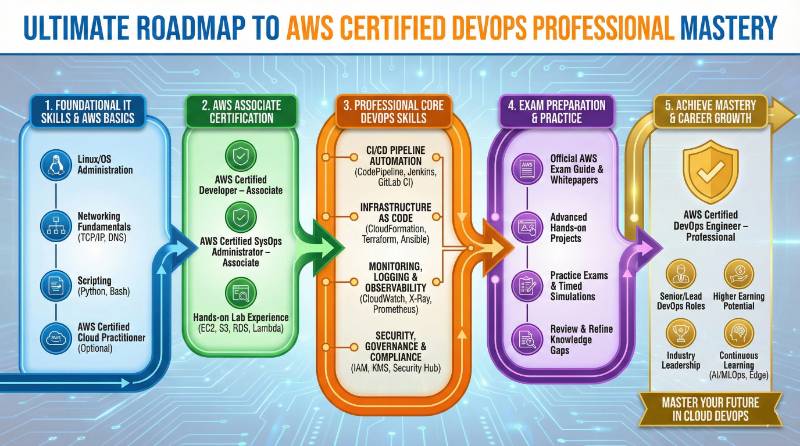
Introduction
Cloud-native teams are expected to ship features fast without breaking reliability, security, or budgets. AWS DevOps Engineer – Professional is designed exactly for engineers and managers who sit at this intersection of speed and stability.
This certification validates your ability to design, automate, and operate production-grade systems on AWS using CI/CD, Infrastructure as Code, observability, and security practices. It is especially relevant for software engineers, DevOps and SRE professionals, and engineering leaders in India and across the globe who want to turn their AWS experience into a recognized, career-boosting credential.
The AWS Certification Landscape
Before we dive deep into the Professional level, it is important to see where it sits in the broader ecosystem. Here is a breakdown of the core certifications that build the foundation for an expert-level career.
| Track | Level | Who it’s for | Prerequisites | Skills Covered | Recommended Order |
| Cloud | Foundational | Beginners & Managers | None | Basic Cloud, Billing, Security | 1st |
| Architect | Associate | Solutions Architects | 1 Year Exp. | Resilient & Cost-effective Design | 2nd |
| Developer | Associate | Software Engineers | 1 Year Exp. | Serverless, SDKs, CI/CD Basics | 2nd |
| SysOps | Associate | System Admins | 1 Year Exp. | Monitoring, Logging, Automation | 2nd |
| DevOps | Professional | DevOps & SREs | 2+ Years Exp. | CI/CD, IaC, HA, Monitoring, Security | 3rd |
| Architect | Professional | Senior Architects | 2+ Years Exp. | Complex Enterprise Architecture | 3rd |
AWS Certified DevOps Engineer – Professional
What it is
The AWS Certified DevOps Engineer – Professional is a top-tier credential that proves you can provision, operate, and manage distributed systems on AWS. It focuses heavily on the “Automation” part of DevOps—ensuring that code moves from a developer’s laptop to a global production environment with zero friction and high security.
Who should take it
- Working Engineers who have mastered the basics of AWS and want to specialize in automation.
- Software Engineers who want to understand the “Ops” side of the house to build more resilient applications.
- Engineering Managers who need to validate the technical strategy of their cloud teams.
- SREs looking to align their site reliability practices with AWS-native services.
Skills you’ll gain
- Advanced CI/CD: Building multi-region pipelines that handle thousands of deployments.
- Infrastructure as Code (IaC): Mastering AWS CloudFormation and the Cloud Development Kit (CDK).
- Automated Governance: Using AWS Config and GuardDuty to ensure every resource is compliant by default.
- Observability: Implementing central logging and advanced monitoring with CloudWatch and X-Ray.
- High Availability & DR: Designing systems that can survive the loss of an entire AWS Region.
Real-world projects you should be able to do
- Automated Blue/Green Deployments: Creating a pipeline that tests a new version in production and rolls back automatically if errors occur.
- Self-Healing Infrastructure: Building systems that automatically detect a failing instance, terminate it, and replace it without manual intervention.
- Centralized Compliance Dashboards: Setting up a real-time dashboard that shows the security health of hundreds of AWS accounts.
- Cost-Aware Scaling: Writing scripts that scale down development environments during off-hours to save thousands of dollars.
Preparation Plan
- 7–14 days (The Expert Sprint):
If you have been living in AWS for years. Focus on the Delta—what has changed in the latest exam version. Take multiple full-length mock exams to build stamina. - 30 days (The Dedicated Learner):
For those with 1-2 years of experience. Spend 2 hours daily. Divide your weeks into: Week 1 (SDLC/CI-CD), Week 2 (IaC/Config Management), Week 3 (Monitoring/Logging), Week 4 (Security/Compliance). - 60 days (The Solid Foundation):
For those moving from Associate level or other clouds. Take it slow. Spend 30 days doing hands-on labs for every service mentioned in the exam guide before starting your theoretical study.
Common mistakes
- Overlooking the “Human” Side: The exam asks for the best solution for a business, not just the most complex one. Sometimes the simplest native service is the correct answer.
- Running Out of Time: The questions are long and scenario-based. If you don’t practice reading fast, you won’t finish.
- Ignoring the “Logs”: Many focus on the “Build” but forget that 20% of the exam is about Monitoring and Incident Response.
Best next certification after this
Once you have conquered the DevOps Pro, the most logical next step is the AWS Certified Security – Specialty or moving toward a broader leadership credential like the Certified DevOps Manager (CDM).
Choose Your Path: 6 Specialized Learning Roads
After obtaining your AWS DevOps Professional certification, the world opens up. Here are six paths you might consider based on your career goals:
- The DevOps Path:
The classic route. You become the master of the pipeline, focusing on speed, efficiency, and developer productivity. - The DevSecOps Path:
Security is the priority. You focus on shifting security to the “left” and automating audits and vulnerability scans. - The SRE Path:
Reliability is your god. You spend your time on SLOs, SLIs, and making sure the system never goes down—and if it does, it recovers instantly. - The AIOps/MLOps Path:
The future of operations. You learn how to deploy and manage Machine Learning models and use AI to predict system failures. - The DataOps Path:
Bridging the gap between data engineering and operations. You ensure that data pipelines are as robust and automated as code pipelines. - The FinOps Path:
The “Cloud Economist.” You focus on maximizing the value of every dollar spent on AWS through tagging, rightsizing, and strategic planning.
Role → Recommended Certifications Mapping
To help you plan your journey, I’ve mapped out the essential certifications for various senior roles in the industry.
| Current/Target Role | Recommended Certifications |
| DevOps Engineer | AWS DevOps Pro, Master in DevOps Engineering (MDE) |
| SRE | AWS DevOps Pro, SRE Certified Professional (SRECP) |
| Platform Engineer | AWS DevOps Pro, Certified Kubernetes Administrator (CKA) |
| Cloud Engineer | AWS SysOps Associate, AWS DevOps Pro |
| Security Engineer | AWS DevOps Pro, DevSecOps Certified Professional (DSOCP) |
| Data Engineer | AWS Data Engineer, DataOps Certified Professional (DOCP) |
| FinOps Practitioner | AWS DevOps Pro, Certified FinOps Professional |
| Engineering Manager | AWS DevOps Pro, Certified DevOps Manager (CDM) |
Top Institutions for Training and Certification
If you need structured training to bridge the gap between where you are and where you want to be, these institutions are the leaders in the field:
- DevOpsSchool:
A powerhouse in technical training. They provide deeply technical bootcamps that go far beyond the exam guide, focusing on real-world implementation. - Cotocus:
Known for their hands-on approach and corporate training. They excel at helping traditional IT teams modernize into cloud-native units. - Scmgalaxy:
A massive repository of knowledge and community-led training. Great for those who want to understand the “why” behind the tools. - BestDevOps:
They live up to the name by offering focused, high-impact training sessions specifically designed for professional-level certifications. - devsecopsschool.com:
The authority on integrating security into the DevOps lifecycle. If you want to specialize in DevSecOps, this is where you start. - sreschool.com:
They focus on the reliability aspect of operations, teaching the Google-born principles of SRE tailored for AWS environments. - aiopsschool.com:
At the cutting edge of MLOps and AIOps training. They help you stay relevant in the age of Artificial Intelligence. - dataopsschool.com:
Dedicated to the automation of data pipelines. They bridge the gap between big data and smooth operations. - finopsschool.com:
Essential for any senior leader. They teach the financial discipline required to manage modern cloud budgets.
Next Certifications to Explore
Based on industry trends and the evolving needs of software engineers, here are three directions you can take after your AWS DevOps Pro:
- Same Track (Deep Specialization): Master in DevOps Engineering (MDE). This is for those who want to be seen as the ultimate authority in the field, covering the entire ecosystem from Docker to Terraform.
- Cross-Track (The AI Frontier): Certified MLOps Manager. As companies scramble to implement AI, the people who know how to run those models reliably are becoming the most sought-after talent in the market.
- Leadership (The Strategic Move): Certified DevOps Manager (CDM). This is for the engineer ready to step into a VP or Director role. It teaches you how to lead people, manage budgets, and drive culture change.
Frequently Asked Questions: Career & Strategy
1. Is the AWS DevOps Professional exam harder than the Architect Professional?
Many find the DevOps Pro harder because it requires deeper “hands-on” knowledge of how services interact, whereas Architect Pro is more about high-level design.
2. How much time should I set aside for studying?
If you are working full-time, expect to put in 10-15 hours a week for 8 weeks to feel truly confident.
3. Are there any formal prerequisites?
While AWS no longer requires you to have an Associate cert first, skipping it is a mistake. The Pro exam assumes you already know the basics of IAM and VPC cold.
4. What is the biggest challenge of this exam?
The clock. You have 180 minutes for 75 complex questions. Most people who fail do so because they run out of time on the last 5-10 questions.
5. Does this certification matter if I already have years of experience?
Yes. In my 20 years, I’ve seen that even experts have “knowledge gaps.” Preparing for this exam forces you to learn parts of AWS you might never touch in your day job.
6. What is the passing score?
You need 750 out of 1000. It is a scaled score, so some questions carry more weight than others.
7. How long is the certification valid?
It stays active for three years. Recertification keeps your skills fresh as AWS releases hundreds of new features annually.
8. Can I take the exam in India?
Yes, there are numerous testing centers across India, and you can also take the exam from your home via online proctoring.
9. Will this help me transition from a Developer to a DevOps role?
Absolutely. It is the gold standard for proving you understand the operational side of software.
10. How much does the exam cost?
The standard price is $300 USD, though you often get a 50% discount voucher after passing an Associate exam.
11. Is Python knowledge required?
You don’t need to be a developer, but you must be able to read and understand basic Python code for AWS Lambda functions and automation scripts.
12. What are the key focus areas?
SDLC Automation (22%), Configuration Management and IaC (17%), Monitoring and Logging (15%), Policies and Standards Automation (10%), Incident and Event Response (18%), and High Availability, Fault Tolerance, and Disaster Recovery (18%).
Specific FAQs: AWS DevOps Engineer – Professional
1. What is the latest exam version?
The current version is DOP-C02. It includes newer services like AWS Organizations and more focus on security automation.
2. Is there a lot of overlap with the SysOps Associate?
Yes, about 30-40% of the content is similar, but the Professional exam goes much deeper into multi-account and multi-region strategies.
3. Which IaC tool is most important for the exam?
AWS CloudFormation is the primary focus, but you should also understand the concepts of the AWS CDK and how OpsWorks (Chef/Puppet) fits in.
4. Does the exam cover third-party tools like Jenkins or Terraform?
Primarily, AWS focuses on its own tools (CodePipeline, CodeBuild, CodeDeploy). However, you should understand how to integrate third-party tools into an AWS workflow.
5. How are the questions structured?
They are almost entirely “Multiple Choice” or “Multiple Response.” Every question is a scenario: “A company has X problem and needs Y result with Z constraint. What do you do?”
6. Is the “Official Study Guide” enough?
It’s a great start, but because AWS changes so fast, the books are often slightly outdated. Always supplement with official AWS Whitepapers and hands-on practice.
7. Can I use a calculator or notes during the exam?
No. It is a closed-book exam. You aren’t allowed any external materials.
8. What happens if I fail?
You have to wait 14 days to retake it. Don’t be discouraged; many senior engineers need two tries to master the specific “AWS way” of answering these questions.
Conclusion
The AWS Certified DevOps Engineer – Professional certification represents significantly more than merely another credential to include on your resume—it’s a substantial confirmation of your capacity to design, automate, and oversee complex cloud systems at enterprise scope. Throughout this handbook, we’ve examined everything from examination structure and preparation approaches to practical capabilities and career directions, providing you a comprehensive blueprint for achievement.
Whether you select to pursue the DevOps, DevSecOps, SRE, or any other specialized pathway, keep in mind that this certification functions as both a milestone and a foundation—it validates your current knowledge while creating opportunities for deeper specialization and leadership prospects. The cloud environment continues developing at remarkable velocity, with AI integration, protection automation, and platform engineering reshaping how we construct and operate systems.

